


"I need an alternator for a BMW E46." — the first answer that request gets on this site today: not at the moment. Same for the E60. For the E90 there is one item in stock, number 12317838656. Three chassis, three answers; where each answer comes from and where it leads is laid out below. Stock checked on 2026-11-20, the pages archived.
A term first: Lichtmaschine is the German word for the alternator, and the German pages of this site use exactly that word — product titles, category entries, the copy of the cross-reference tool; it is the site's own vocabulary, not a translation flavor. This article follows the site's usage; by number we mean the OE number throughout. The lookup flow keeps its five steps: chassis page → label number → field check → interchange family → VIN inquiry. Whether the battery warning light stays on or the charging misbehaves — that "is my alternator failing" question is diagnosis and not this article's topic; there is a dedicated alternator symptoms guide.
Three chassis, three answers: the conclusion first
The E90 answer is the easiest: one chassis-coded alternator is in stock; the German product page title, verbatim, is "Lichtmaschine für BMW (E93 / E90 / F18 / F35)", OE number 12317838656, and the Fits block states in four lines, in black and white, "E90 2005 – 2011". Chapter 3 builds the field card for it; the fields stand, you check against them.
The E46 and E60 answer has to speak in counts: across the four pages of the E46 chassis page, 91 listed items, of which zero alternators; across five pages of the E60 chassis page, 112 items, again zero; and among the 50 items of the alternator category, not one is coded to these two chassis. Zero stock is not a full stop — chapter 4 gives the complete path from the old part's label number to the inquiry; for readers of these two chassis, the path itself is this article's delivery.
Reading map: with an E90, the field card in chapter 3 plus the final check in chapter 6 is the whole process. With an E46 or E60, chapter 4 is your chapter, and the number-finding method of chapter 2 belongs to it. With the number already in hand, jump straight to the interchange families in chapter 5. Nobody has to read in order.
Where your alternator's number sits and what it looks like
The number is on the old part, not in the vehicle's spec sheet. The alternator housing carries a label or plate with the eleven-digit OE number; photograph it before the part comes out. The packaging label usually shows the same number — the original box from the original order is the first backup. Each later step runs on this number: stock search, family lookup, inquiry.
Three practical notes on photographing: for the label shot, square the characters to the lens and kill the reflections — smeared digits equal a shot not taken. One flat full-view shot of the whole unit; one extra of the pulley and connector side. These three photos serve the inquiry and the goods-in check; shooting them once saves taking the part off twice.
What the number looks like, the stock itself says: of the 19 BMW items in the alternator category, each number is eleven digits, and apart from one X5 item numbered 12318634231 (a 12318 block), 18 start with 12317. That is today's site finding, not a block rule — how BMW numbers are built and what each block means is properly covered in the number-reading guide; this article deals in real parts and does not use prefixes as filters (chapter 5 holds a counterexample).
Why the label number outranks "derive it from the model": within one chassis code, variants coexist — the site itself supplies the example; the E90 item's application statement hangs two engine variants, M3 (309KW,420PS) and M3 CRT (331KW,450PS), on the same number. The category's naming shows the layering as well: within the same 3 Series, ordinary items and M3 variants carry separate numbers. The spec sheet does not answer which variant sits in your car; the label does.
If the old part is already gone and the label is worn through, there are three fallback layers in order of reliability: the original packaging label, old photos of the part (if any were taken), and, failing both, an inquiry with the VIN so the number is traced from the vehicle side. The VIN sits at the lower-left windshield, on the door-jamb plate, and in the registration — the chassis code guide maps the locations and the code rules in detail; which generation hides behind E46, E60 and E90 is one lookup there.
One hands-on note: the alternator sits at the side of the engine, pulley facing out, label facing the block — oil sludge and rust sit thicker there than on almost any other part. Wipe the label zone with a cloth before shooting, and read the eleven digits back one by one: O, 0, I and 1 alternating is not rare in alternator numbers, and this wipe is cheaper than later squinting at a blurry photo.
E90: the item in stock and its fields
Table 1 lines up this item's site fields; the "site value" column quotes the product page verbatim, unedited. The text occasionally uses a shorthand: 12317838656 becomes 8656 — that only saves ink; ordering, lookup and inquiry each run on the full number.
| Field | Site value (verbatim) |
|---|---|
| Name (DE product page) | Lichtmaschine für BMW (E93 / E90 / F18 / F35) |
| OE / sku / mpn | 12317838656 |
| Fits block (4 lines) | E93 2007 – 2013 · E90 2005 – 2011 · F18 2010 – 2017 · F35 2012 – 2019 |
| Application statement | 7 Fahrzeuganwendungen für BMW über 3 Modelle · darunter 3 Convertible und 3 Coupe · mit Modelljahren 2006–2013 |
| Engine variants | M3 (309KW,420PS) · M3 CRT (331KW,450PS) |
| Self-description | Aftermarket-Ersatzteil für OE 12317838656 |
The Supply group carries further supplier statements (among them the voltage line) with noise; the text quotes them in their own paragraph and keeps them out of this table.
The field card is read in order, and each field answers one question: the OE number says which item this is; the Fits block says which generations it serves; the application statement says how the supplier declares it; the engine variants say which variants are named outright. The order is the order of ordering confidence — identify the part, check the fit, then match the variant info against your own car. And when fields disagree, one rule holds: fit per the Fits block; supplier noise lines (the voltage line in the next paragraph) take no part in the decision.
The Fits block is this item's fitment statement — literally the four lines in the table. E90 is the 3 Series generation of 2005–2011; which generation and body hide behind E93, F18 and F35, the codes standing beside E90 in the name, is tabulated in the chassis code guide — one item spanning four codes rests on shared parts within and across generations; how far the span reaches and whether your car falls inside it is decided by these four lines and the VIN, not by assumption beyond the page.
The application statement in plain words: in the supplier's fitment table this item carries 7 vehicle applications across 3 models (7 Fahrzeuganwendungen für BMW über 3 Modelle), the body forms name 3 Convertible und 3 Coupe, the year span runs mit Modelljahren 2006–2013, and the engine variants are the two in the table. These are supplier data transcribed by the site, quoted here as they stand; whether you trust them is settled at the end by your own label number plus VIN — not by the declaration.
The Supply group also holds a voltage line, verbatim "5 SERIES 2004-2005 24v 48v & 100a 200a" — a 5 Series, 2004-2005, which does not match this item's Fits block; 24v, 48v, 100a and 200a crowding one line. That is supplier noise inside the site data: the operator transcribes the fields as the supplier delivers them, without cleaning, and this article quotes them unedited. The discipline matches the site's own: fit per the Fits block; noise lines are not an ordering basis. How voltage and current match the car is outside this article's scope — a vehicle-side question that one line on a part page cannot answer.
Where the item hangs: page one of the E90 chassis page, page one of the alternator category — as a BMW-E90 alternator, currently the one item in stock coded to that chassis. The product card renders on the site itself; this article does not double-link it.
E46 and E60: the honest answer about today's stock
The numbers first (checked 2026-11-20): the fitment/E46 chassis page runs four pages, 91 items, alternators zero; fitment/E60 runs five pages, 112 items, zero; the alternator category counts 50 items (BMW 19, Mercedes-Benz 25, Land Rover 6), none coded to E46 or E60; the E90 side has 52 items with exactly one — the item from chapter 3. Three checkpoints, one conclusion; see table 2.
| Chassis | fitment pages total | alternators among them | stock anchor | next step |
|---|---|---|---|---|
| E46 | 4 pages, 91 items | 0 | — | label number → cross-reference tool → VIN inquiry |
| E60 | 5 pages, 112 items | 0 | — | same path as E46 |
| E90 | 3 pages, 52 items | 1 | alternator-e93 (OE 12317838656) | field-card check → label number + VIN final check |
Checked 2026-11-20; the pages are archived in the research folder. Stock moves after that date belong to the site's pages; this article predicts no restocking.
The obvious question: the E46 fleet is huge — is there no "common numbers" list? There is not, and there should not be. The site is triple-empty for these two chassis: chassis pages zero, category zero codings, cross-reference tool without a number source. The B1 article once gave catalog numbers for the E36 because a catalog mirror had been archived at the time; for E46 and E60 nothing is archived, and the site holds nothing either — so this article invents not one number and delivers paths only. Writing a number from memory into an article shifts the cost of the wrong order onto the reader.
How to read these counts matters too. Ninety-one items does not mean "nothing for the E46" — the chassis page is alive: oil filter housings supply 66 of the 91 items, oil filler caps 6, suspension items queue behind; only the alternator is missing as a class. The category's 50 items show the alternator line itself is traded (BMW, Mercedes-Benz and Land Rover in the count) — what is missing are items coded to these two chassis. These two findings say nothing about "when will stock come" — the site announces none and this article forecasts none; on "where do I look now" they settle the answer: an E46 or E60 alternator is not to be found on the site at this moment; the next stations are the cross-reference tool and the inquiry.
That the article is still worth writing is the path itself. E46 and E60 readers take away three things: the evidenced "not on the site right now", so nobody scrolls the category endlessly; a lookup method that starts at the label number and keeps using the cross-reference tool; and an inquiry entry that hands over VIN and photos in one move. The road past those three is more than a bare "out of stock".
The right route starts from the number, not the chassis: old label number → enter it in full in the cross-reference tool → on a hit, run the chapter 3 field-card check; on no match, go to the inquiry. The inquiry carries the VIN and three photos (label close-up, whole unit, pulley and connectors); the site states "innerhalb von 4 Stunden während der Geschäftszeiten" for its answer. A number in hand and vehicle data complete — that is harder than any "common numbers" list.
The E60 is handled exactly like the E46. Both chassis pages are still worth a walk: sorted by system, oil filter housings dominate the E46 page (66 of 91 items), oil filler caps and suspension parts follow; on the E60 page the housings lead as well, with plenty of titles reading "(E46 / E60)" outright — shared parts across the two chassis are normal on this site; only the alternator is missing on both sides. The lookup route is shared; the anchor alone is absent.
Interchange families today: three hands-on examples
Item and number are not one-to-one: behind one number can hang a chain of interchange numbers. The cross-reference tool's phrasing, German interface verbatim, is "Primäre Teilenummer" (primary number) plus the list of interchange numbers; on a hit it first reports a count like "1 passendes Teil". What a family means needs saying precisely: it expresses a supply relationship — these numbers count as the same item on the supply side — and not a fitment statement. Fitment is read from each item's own Fits block; the family does not replace it.
- 12317838656 → single-member family: only the number itself, no interchange number. A single-member family is a normal result — not a sign of an obscure or nonexistent number.
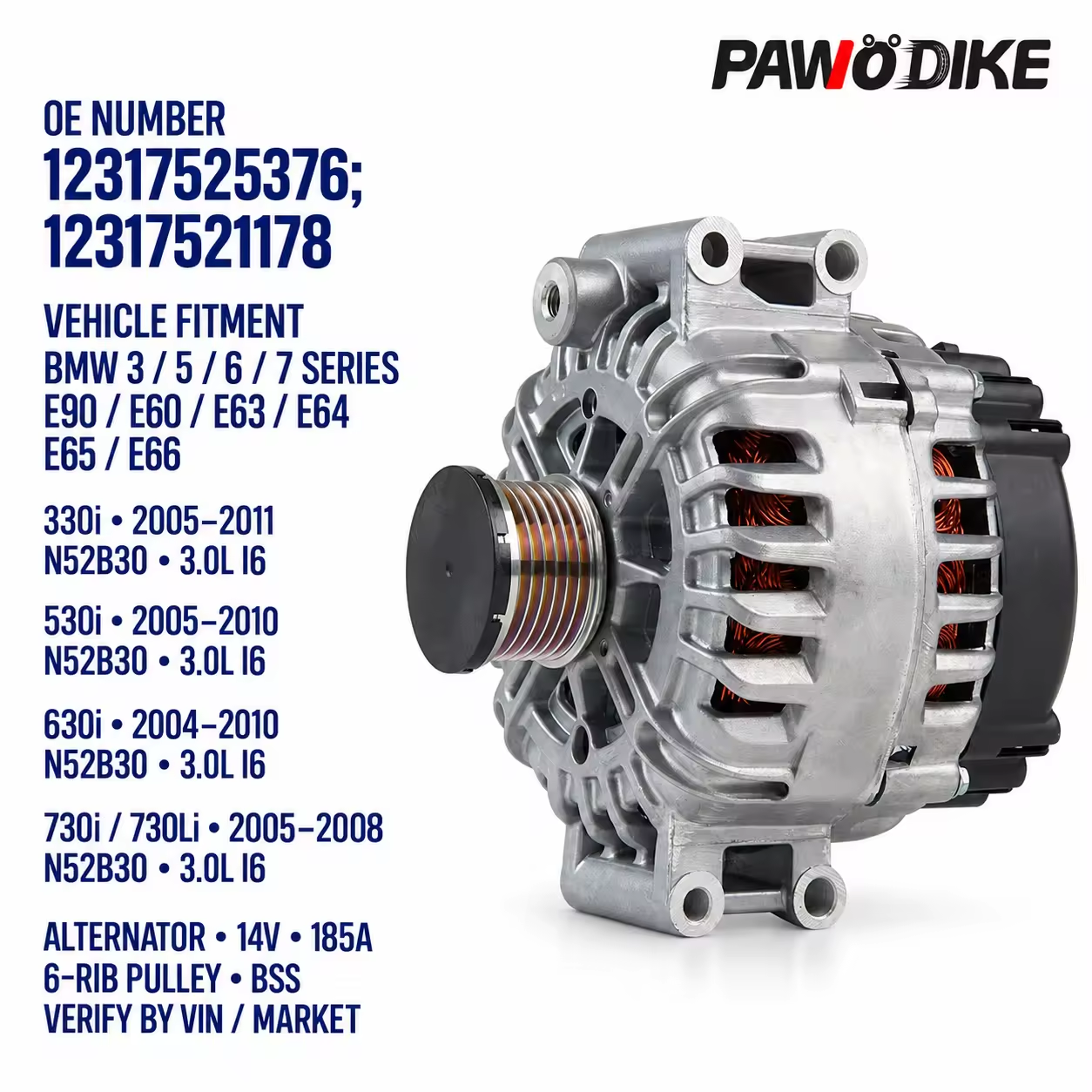
- 12317525376 → two-member family: interchanges with 12317521178. The primary item is the category's "Lichtmaschine für BMW 3er / 5er / 7er".
- 12317605479 → two-member family: interchanges with 12319845478 — one number from the 12317 block, one from the 12318; family members do not share a block by necessity, and number blocks are not boundaries.
The third family is the best lesson. Screen by the instinct that alternator numbers start with 12317 — chapter 2 noted it, and 18 of the site's 19 items indeed do — and a family member like 12319845478 falls through the sieve. The right move: enter the full number in the tool; a prefix is a statistical appearance, not a filter criterion. For E46 and E60 readers this weighs double: with no anchor item, losing the family member makes the whole search a wasted trip.
Families work forwards and backwards. Forwards: your label number finds no product page carrying it — do not conclude hastily; the number may hang as a family member under another item; the 5376/21178 pair points both ways. Backwards: a number from some other purchase record or old papers — run it through the family first, then compare with the site; that prevents double-ordering the same part under two numbers. Even the single-member family earns its keep: it confirms the number stands as its own part and will not be shouldered aside by a "close enough" one.
No hit (no match): check the look-alike pairs first — O against 0, I against 1, B against 8; an alternator label spends a decade-plus in the engine bay, and oil, dirt and corrosion pick on exactly these three pairs. Still no hit, then inquire. The extended version of these pairs is in the number-reading guide.
The general chassis lookup method and the E36 and 750i examples are in the B1 article; its German version is online, titled "BMW-Lichtmaschinen-Teilenummern nach Chassis-Code: so schlagen Sie sie nach". This article covers only the three chassis E46, E60 and E90. The two are counter-entries: the general one first, or straight to your own chassis.
The final check before you order an alternator
- 01The old part's label number: check the full number first against the numbers met in this article (12317838656 and the four family examples); no match, enter it in the cross-reference tool.
- 02Three photos: label close-up, whole unit, pulley and connectors — the inquiry wants them, the goods-in check wants them too.
- 03The VIN: the chassis code does not answer variant questions; the VIN does; attach it to each inquiry.
- 04On arrival, check the number first: read the delivered part's label before installing; number off, report at once — no forced install.
Each of the four checks stops its own error: the label stops "same name, different number"; the photos stop "what arrived is not what was pictured"; the VIN stops the variant mismatch; the goods-in check stops the last error on the logistics and warehouse leg. Unbolting a wrongly ordered alternator again costs labor and shipping — not a new sentence, but one that earns its place on the checklist.
"Same car, same part" is not accepted as proven. Two cars of the same code and year can carry different alternators because of the engine variant — the stock item hanging both M3 and M3 CRT variants is the positive example; conversely, an 8656 that fitted someone else's E90 smoothly does not make it yours. The label number decides.
What an inquiry should look like is one sentence: full number, VIN, three photos, one line of chassis code and year. Model plus build year alone is not enough — the 3 Series of 05/06 sits exactly on the generation seam (the site's E46 fitment line runs to 2006, the E90 line starts 2005); the build year alone does not split the generations, and with the VIN it is decided at once. The photos cover what the VIN cannot: the actual part's condition and connector layout.
Do not skip the half step at goods-in: open the box and read the delivered part's label before it goes on the car. Number right, install; number wrong, report at once and keep packaging and label intact — returns and swaps recognize things, not memories.
To close: the E90 has its anchor — the field-card way; the E46 and E60 have no stock — the label-number-to-inquiry way. Three chassis, three routes, one shared start: the eleven digits on the old part. Photograph them clearly; each step after that is caught by a page on this site.
Common questions
- Welche Lichtmaschine passt an den BMW E46?
- There is currently no E46-coded alternator item on the site: zero of 91 items across the four chassis pages, no coding among the 50 category items, no number source in the cross-reference tool. This article derives no E46 number — the path runs from the label number plus VIN through tool and inquiry (chapter 4).
- Welche Lichtmaschine passt an den BMW E60?
- The same situation: five chassis pages, 112 items, zero alternators. The path as for the E46: label number → entered in full in the tool → on no match, the inquiry with VIN and three photos.
- Passt die Lichtmaschine 12317838656 an den E90?
- Per the site, the Fits block contains "E90 2005 – 2011" (the same item also hangs on E93 2007 – 2013, F18 2010 – 2017, F35 2012 – 2019); the application statement names the M3 and M3 CRT variants. Final say belongs to the label number plus VIN (field card in chapter 3).
- Was heißt «Primäre Teilenummer» im Kreuzreferenz-Tool?
- The tool's field phrasing: the hit's primary number (for instance 12317838656) with its list of interchange numbers. This item is currently a single-member family — no interchange number is a normal result, not an error (the three examples in chapter 5).
- Sind Austauschnummern automatisch auch passend?
- No. The family expresses a supply relationship, not fitment; fitment is read from each item's own Fits block, finalized with the VIN. That 12317605479 and 12319845478 form a family in the site reading and yet belong to two number blocks is the telling example: family is not fitment, block is not boundary.
Got a part number or a VIN? Get availability and price — we reply within four business hours with price and lead time attached.