


The step that follows "I need a BMW alternator" is not picking a part; it is naming the chassis code. The same sentence — "an alternator for a 3 Series" — can point at an E36 from the 1990s or a G20 from recent years, twenty-plus years of part numbers apart. This guide walks the full lookup: how to read the one chassis-coded listing in stock, how model-level listings resolve down to a chassis (a 750i example verified against three sources), how interchange families work, and what to send us when your chassis is not in the listing for now (E36). Each part number in this article traces to a product page on this site or a public BMW parts catalog.
You need a BMW alternator: start with the chassis, not the model name
The whole route up front: chassis code → locate candidate numbers in our listings or the public catalog → check the interchange family in the cross-reference → confirm with the VIN before ordering. Four stages, each answering one question — which car, which number, which family, which configuration. The sections that follow take these four steps apart, and each step comes with actions you can copy directly.
"Get me an alternator for a 3 Series." That request cannot be executed as stated in BMW's part-number system. "3 Series" is a name shared across generations — E36, E46, E90, F30, G20, five generations of cars under one badge — with entirely different bodies, engines, and electrical systems. Pin down a year, and the sedan, touring, and convertible still often carry separate chassis codes. A model name run against a parts catalog returns pages of "maybe," not one definite number.
So the first step in finding an alternator number is the chassis code. It looks like a letter plus two digits — E90, F18, E65 — the E series (Entwicklung, development) followed by the F and G generations. One level more precise than a model name, which usually spreads across several codes at once; one level coarser than a VIN, which identifies a single car; in between sits the granularity a parts lookup actually needs. Where the code is stamped on the car and how to read it out of the VIN is a topic of its own: where to find the chassis code.
Why do alternators in particular call for the chassis? Because they straddle two systems, mechanical and electrical: mounting brackets, pulley, connector form, output behavior — each follows the generation. Engine-bay layout changes from one generation to the next, and cross-generation interchange is close to nonexistent for alternators. "My friend's car is also a 3 Series, so his number works for me" fails between an E46 and an E90. Two extra minutes fixing the chassis beats shipping the wrong unit and unwinding a return.
Alternators sit in the electrical class of parts, and BMW electrical numbers open with 123. The alternator category page lists the current stock number by number; first, what these numbers look like.
What a BMW alternator part number looks like
One alternator from our stock, OE number 12317838656: eleven digits, opening with 123 — the class BMW's numbering reserves for alternators. In parts catalogs the same number is usually printed in spaced groups, 12 31 7 838 656. Same number, two notations; strip the spaces when searching or requesting a quote.
Read it by groups: the leading digits give the class and subgroup, the middle run is a structural sequence, the tail is version and variant. The full digit-by-digit breakdown has its own article — how to read Mercedes and BMW part numbers — and one takeaway matters most to buyers: differences in the tail often mark interchangeable versions within the same family, which is why "the first digits match" is not a match.
Product links on this site are named by OE number: what follows /product/alternator- in the URL is the eleven-digit number itself. A link picked up from search results or someone else's share tells you its number straight from the address bar — handy when checking whether the number someone recommended and the one you looked up are the same.
A common follow-up: why quote the OE number rather than the brand number cast into the housing? The alternator for one car position may come from several suppliers, each with its own model scheme; the OE number is the unified index in the manufacturer's engineering catalog — one car, one position, one family of numbers, no ambiguity when matching. Nameplates usually carry the OE number and the supplier's number side by side; photograph both.
The one chassis-coded alternator in stock: 12317838656
The alternator category currently holds 50 units — 20 BMW, 25 Mercedes-Benz, 5 Land Rover — and exactly one of them carries its chassis codes directly in the fitment information: 12317838656. Its product page's "Fits these vehicles" block reads, verbatim:
- BMW 3 Series Convertible · E93 · 2007–2013
- BMW 3 Series · E90 · 2005–2011
- BMW 5 Series Li · F18 · 2010–2017
- BMW 3 Series Li · F35 · 2012–2019
The engine-variant column names M3 (309KW, 420PS) and M3 CRT (331KW, 450PS) — the high-performance variants under the same chassis, called out individually, which shows how tightly the fitment is drawn. The year ranges are model years; the four rows together — model name, chassis code, years, engine variant — pin the application down. An E93 convertible owner matches on the first row, a long-wheelbase F18 five-series owner on the third; that is what chassis-level labeling buys.
The page also carries a seven-row compatibility table, declared "as supplied by the listing." Take the declaration literally: the table is the supplier's list, its wording may not line up with the factory catalog, gaps included — fitment is confirmed against "Fits these vehicles," and the table serves as reference. That is the standing convention on our product pages, not boilerplate.
Why does the site label by model almost everywhere and by chassis only here? Because supplier lists normally arrive at model granularity, and chassis-level labeling can be written only after checking each row against the factory catalog. This one unit carries four layers of information because the list and the catalog lined up; the next section covers how to resolve model-level numbers down to a chassis yourself — the everyday case.
The chassis pages for E90, E93, F18, and F35 list this alternator. Chassis page into category, category into product page — both routes work.
From model-level numbers down to the chassis
The remaining 18 BMW alternators in stock are labeled by model — at the granularity of "5 Series / 7 Series," "X5," "3 Series" — and each page carries the same note: confirm before ordering. Table 1 lists the 18 numbers with their site labeling.
| Part number (OE) | Site labeling |
|---|---|
| 12317063782 | 5 Series |
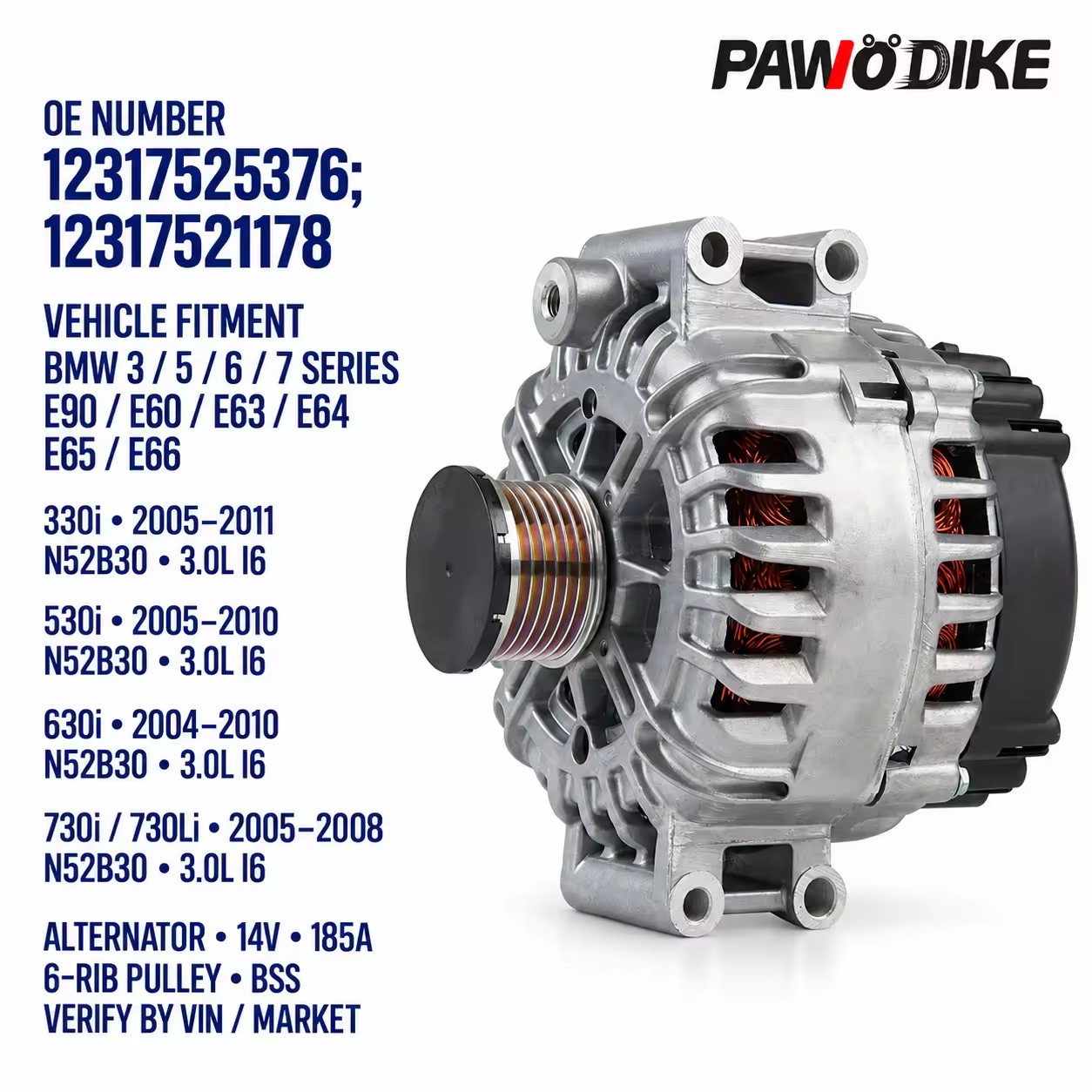
| 12317525376 | 3 / 5 / 7 Series |
| 12317533270 | 3 Series |
| 12317542934 | 5 / 7 Series |
| 12317546285 | 5 Series |
| 12317555926 | X5 |
| 12317560986 | X5 |
| 12317560988 | X5 |
| 12317576513 | X5 |
| 12317591268 | 3 Series |
| 12317591529 | 5 / X5 / X6 |
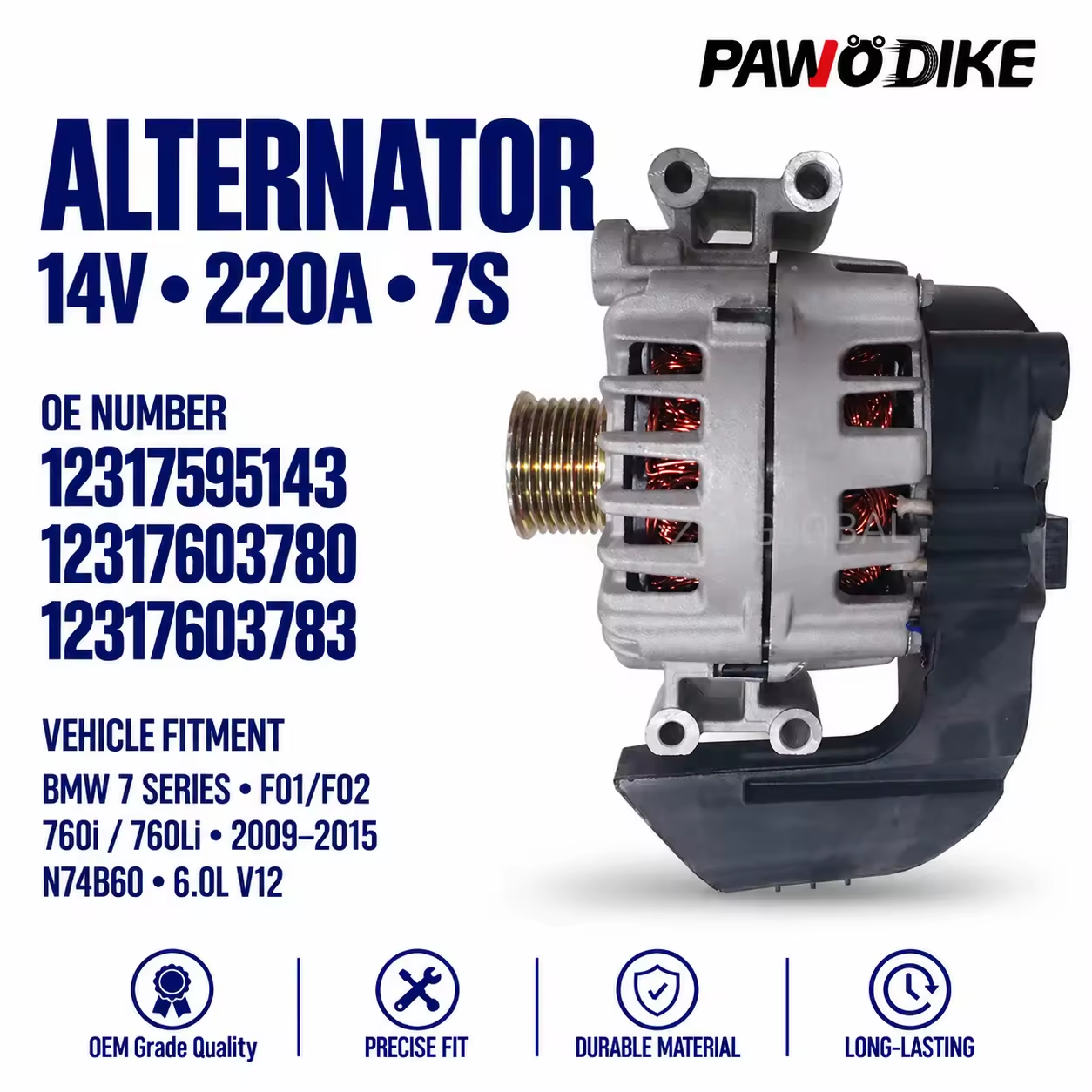
| 12317595143 | 7 Series |
| 12317603778 | 7 / X6 |
| 12317605479 | 3 Series |
| 12317610260 | 1 Series |
| 12317616121 | X5 / X6 |
| 12317628243 | X1 |
| 12318634231 | X5 |
Site labeling is at model level; fitment is confirmed against each product page's Fits these vehicles block and compatibility table. 12317542934 is the 750i example below.
SUVs behave the same way. Six numbers in Table 1 are labeled X5, but the X5 name has run from E53 through E70 and F15 to G05 — four generations under one badge. A number labeled "X5" likewise resolves only against "which generation of X5"; the situation matches the 3 Series exactly, and it is the one buyers of SUV parts most often overlook.
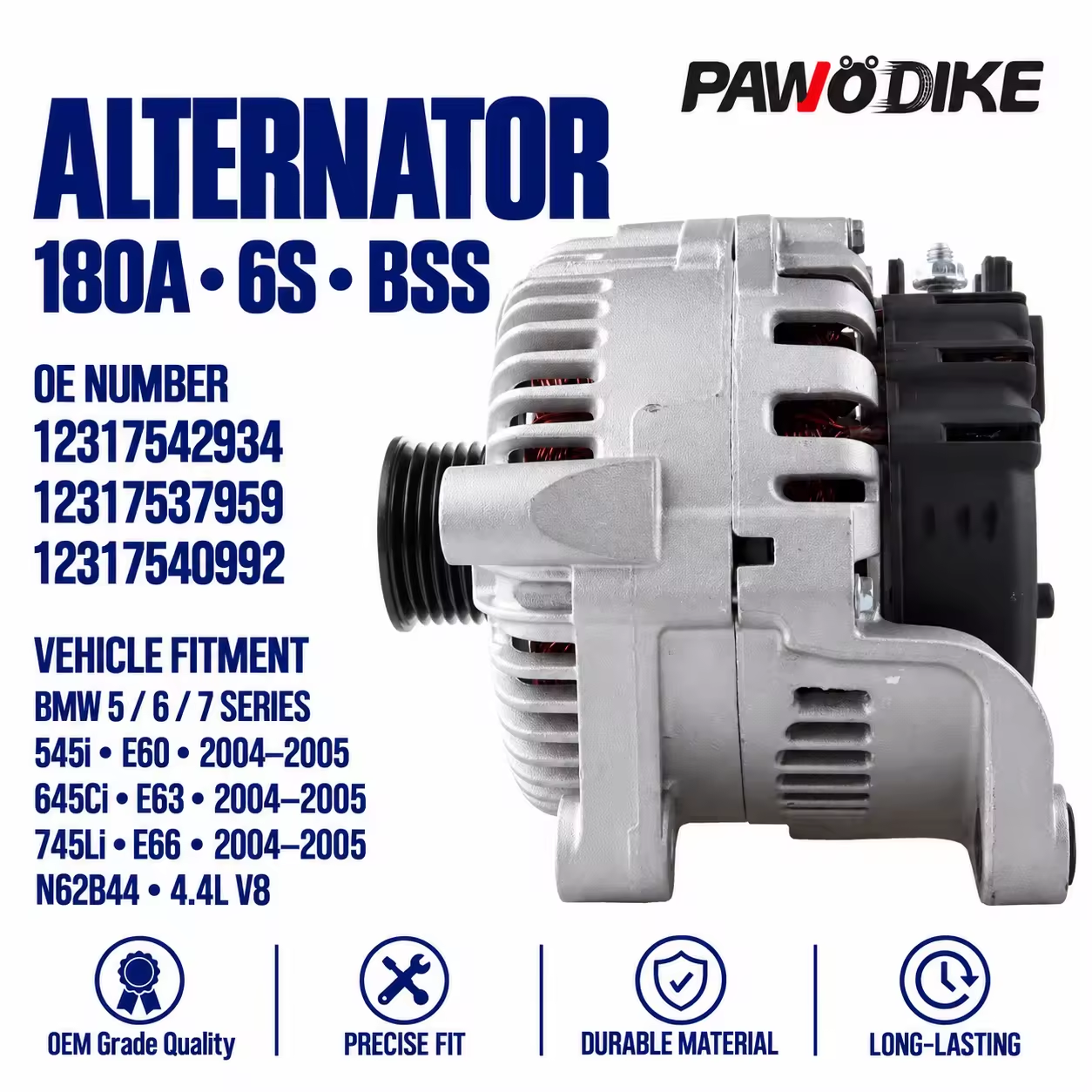
Model-level labeling is not unusable; it means the buyer performs the chassis step. A frequent request serves as the full worked example: the 750i (E65). The site stocks 12317542934, labeled "Alternator for BMW 5 Series / 7 Series, also replaces 12317537959." Set "750i" against three sources:
- 01In the public BMW parts catalog (ETK), the alternator group for the E65 750i (N62 engine) lists two numbers — 12 31 7 542 934 and 12 31 7 542 935 — with the supplement 180 A, from March 2005. Strip the spaces from 12 31 7 542 934 and you have 12317542934, the number in our stock.
- 02The product page's compatibility table (reproduced as supplied) contains the row "BMW 7 · 2005.03–2008.08 · 750 i, Li (270KW, 367PS)."
- 03The cross-reference tool, given 12317542934, returns the primary number and its interchange family (12317537959 among them).
The fourth step is the VIN confirmation before ordering — the very step "confirm before ordering" refers to; part of the process, not a disclaimer. A VIN locks in the configuration differences hiding inside "same year, same chassis" (build month, electrical equipment), something neither the model name nor the chassis code can do.
Most buyers rarely touch a parts catalog, and that is fine: of the three sources you can complete two yourself — find the model-level number on the category page, and your model's row in the compatibility table — and leave the catalog comparison to us. Give the model, year, and VIN in your inquiry, and someone walks the catalog step for you. One source fewer, one question more; the conclusion stands.
One trap worth flagging: the 2010–2017 generation of the 5 Series splits into F10 (standard wheelbase) and F18 (long wheelbase); the catalog lists them separately, and the alternator our site carries for that generation, under F18, is 12317838656. Say "which generation, which wheelbase" when requesting, or the right fitment list stays out of reach — "a 5 Series" alone buys another round of questions on both sides.
Interchangeable numbers and the cross-reference
A full number rarely stands alone: it replaces an older number and is in turn replaced by a newer one. Product pages state the relation as "also replaces," and the cross-reference tool expands it into the complete interchange family. The pairs currently in stock, agreeing across both sources (page label plus tool output):
- 12317525376 ↔ 12317521178
- 12317595143 ↔ 12317603780
- 12317533270 ↔ 12317543083
- 12317542934 ↔ 12317537959 (the 750i example above)
Using the tool: enter any number — the OE number, the older one it replaces, or any member of the family — and it returns the primary number and the full family. Replacement chains run old to new, and entering at any link pulls the chain whole. When a number returns no match, the handling procedure has its own section in the number-reading article: what to do when the cross-reference tool finds no match.
Why families matter to buyers: the nameplate on the old unit in the car often carries the replaced, older number. The 750i unit is the ready example — a removed original very likely reads 12317537959, absent from category-listing titles yet inside the interchange family of 12317542934. A number that returns nothing does not mean no stock; run the family in the tool before concluding.
Nor is a family limited to two members: the tool returns the full family, and some numbers are pointed at by several older ones. Do not stop at the single number after "also replaces" — check the whole family the tool returns, particularly when the old number in your hand appears on no product page.
When your chassis is not in the listing: the E36 example
The alternator category currently carries no E36 number, and the E36 fitment page lists valve covers, oil caps, and suspension pieces — no alternator. If you drive an E36, set the expectation accordingly: no alternator for that chassis in the site's listings for now, but the public catalog holds numbers, so an inquiry has something to stand on. Not a dead end.
In the public BMW parts catalog (ETK), the alternator group for the E36 sedan 325i (M50 engine, US-market catalog) assigns numbers by build date and amperage; Table 2 reproduces them:
| Catalog number | Catalog supplement | Catalog date range |
|---|---|---|
| 12311735403 | 105 A | through 1991-09 |
| 12311738092 | 140 A | 1991-02 to 1991-09 |
| 12311744560 | 80 A | from 1991-09 (version change at 1995-04) |
| 12311744564 | 80 A | from 1991-09 (version change at 1995-04) |
| 12311744565 | 80 A | from 1991-09 (version change at 1995-04) |
| 12311744567 | same group | no amperage supplement given |
Source: public BMW parts catalog mirror (E36 sedan 325i M50, US market, alternator group); archived in our research records.
The lesson of this one unit is plain: the same 325i built between 1991-02 and 1991-09 may carry the 140 A 12311738092, while anything after 1991-09 takes the 80 A series — the chassis gets you to the number, the build date separates them. The catalog's date ranges (from–to) are build-date segments; match them against the production plate on your car. Engines under the same chassis group separately as well — 318i (M42/M44), 320i (M50), 328i (M52), M3 (S52) — each with numbers of its own.
The complete E36 routine, in three steps: first fix the candidate number in the catalog by engine and build date (Table 2 covers the 325i); then photograph the nameplate before removing the old unit — the catalog number says what the factory may have fitted, the nameplate says what this car actually carries, and a later repair may have swapped the part, so the physical unit decides; finally send the VIN, the nameplate photo, and the candidate number in one inquiry, and we answer by part number.
If the old unit is already off the car and the nameplate is worn past reading, a path remains: VIN plus engine code plus the production date on the body plate narrows the candidates to a short list, though confirmation takes longer than a legible nameplate would. Hence the standing advice to photograph before removal — that one picture is the cheapest, most informative step in the whole routine.
One more caveat on scope: Table 2 comes from the US-market catalog. Parts catalogs are issued by market, and the same model may sit under different numbers in another market because of equipment differences. That is why this article stops short of "an E36 325i takes number such-and-such" — chassis, engine, date, and market each fixed, only then is the number fixed; and on your specific car, the VIN is the one credential that settles everything at once.
F10 follows the same route: no F10-labeled alternator in stock, the long-wheelbase F18 of the same generation carries 12317838656, and F10 owners use the VIN inquiry path as well. Whether a chassis outside the listings can be supplied is settled by the inquiry reply, not promised in advance — which is also why each product page reads confirm before ordering.
The final check before you order an alternator
However the number was found, the last gate before ordering is the old unit itself. For alternators, four fields to check:
- 01Nameplate number — the eleven digits on the old unit's body. It may be the older number within an interchange family; that is normal, so run it through the cross-reference tool and confirm against the stocked number.
- 02Connector form — the shape and pin count of the electrical plug. Forms differ across generations, and a photograph beats a verbal description.
- 03Pulley grooves — count them. Single-groove and multi-groove units do not interchange, and discovering that after fitting the belt is the expensive way to learn.
- 04Regulator type — internal or external, tied to the car's electrical architecture; a mismatch can upset the charge-indicator behavior.
Photograph three frames in one pass: a nameplate close-up (number, amperage, and supplier logo legible), a top view of the unit (outline and pulley visible), and a close-up of the connector. One good photo saves three rounds of back-and-forth. Add the VIN and your candidate number to the inquiry.
The old unit has the final say on each of the four checks; "same car, same part" is not an inference we accept — the E36 325i already showed that two build months can mean two different numbers. One more check waits after delivery: match the number on the unit's nameplate against the order before booking the installation, and problems stay upstream of the wrench. As for "battery or alternator," the testing order lives here: bad alternator symptoms and how to test.
Common questions
- How do I find the alternator part number for my BMW?
- Four steps: fix the chassis code (door-jamb plate or VIN; the method is in the chassis-code article), filter the alternator category page or the chassis fitment page by chassis and model, note the OE number, then run it through the cross-reference tool to confirm the old number in your hand belongs to the same family as the stocked one.
- Is the alternator part number the same as the chassis code?
- No. The chassis code locates the car (E90); the part number locates the part (12317838656). The two appear as a pair in product-page fitment information — a specific number listed under a specific chassis code is what "fits" rests on.
- What does alternator 12317838656 fit?
- Verbatim from the product page's fitment block: BMW 3 Series Convertible (E93, 2007–2013), BMW 3 Series (E90, 2005–2011), BMW 5 Series Li (F18, 2010–2017), BMW 3 Series Li (F35, 2012–2019), with engine variants M3 (309KW, 420PS) and M3 CRT (331KW, 450PS).
- Do all BMW 3 Series use the same alternator?
- No. The 3 Series name runs from E36 to G20; the stocked 3 Series numbers separate by chassis and engine (12317838656 is listed under E90/E93, while 12317533270, 12317591268, and 12317605479 carry the 3 Series label), and the E36 325i changes numbers by build date even within the catalog. Cross-generation universality does not exist — match on chassis, engine, and build date.
- My chassis is not listed — can you still supply the alternator?
- A chassis outside the listings (E36 or F10, for example) is not a dead end: the catalog numbers can be found (Table 2 holds the E36 325i's), and sending them with the VIN and a photo of the old nameplate gets you an answer by part number. Whether an unlisted chassis can be supplied is settled by the inquiry reply, not promised in advance — which is also why each product page reads confirm before ordering.
Got a part number or a VIN? Get availability and price — we reply within four business hours with price and lead time attached.