


"I need a control arm for an E46." — On the E46, that sentence goes wrong more easily than on other chassis. One generation, one code, yet four items in stock, each with its own number; one digit off and the arm will not fit. This article walks the full path to the right number: how to read the four in-stock listings field by field, how left and right get settled, what the «Ersetzt auch» families and the cross-reference tool do, how noise rows in the compatibility table read, and what to check before ordering. Each number in this text traces to a product page on the site or to an archived cross-reference query; numbers the site does not carry, and numbers without a source, do not get written. The method follows the alternator guide; the examples come from the E46 control-arm side of the site.
The five-step workflow stays as it was: enter through the E46 chassis page, shortlist the candidates, check the product-page fields one by one, look the family up in the cross-reference, confirm with the VIN. The E46 is one of the chassis where this path runs smoothest — four control arms in stock, fields complete, family relations clear, and the German pages are native German. Fields and row counts below reflect the site as read on 2026-11-20.
One word up front: Querlenker is the German term for the control arm. The German product page is titled «Querlenker für BMW 3er (E46)» — in this text, "control arm" and Querlenker mean the same class of part; field values are quoted from the English pages, and the German pages match them.
Within one E46 generation, the control arm is not one number
The E46 is the chassis code of the BMW 3 Series from 1998 to 2006; one code covers the full variant range — saloon, Touring, Compact, Coupé and Cabrio count as E46. Where the code comes from and where on the plate you read it is covered in the chassis-codes guide; the result is used directly here.
How the chassis page works, in brief: it gathers the in-stock items under a chassis code and breaks them down by system; from category to a single product page is two clicks. On 2026-11-20 it carried 19 items (table 2 in chapter 5 has the full list), the four control arms among them — the "shortlist the candidates" step ends at exactly these four on the E46. The pages follow the systems: control arms, shock absorbers and bearings have a page each, so there is no sifting page by page.
Within one generation, the control arm splits by position first. The fitting-position statement on the product pages has two levels only, verbatim: "Fitting position: Front." and "Fitting position: Lower.". Of the four in-stock items, 31126777939 states Front; the other three state Lower.
Within one position level there is more than one number: the Lower level alone holds three items — 31126777852, 31126752717, 31126777851 — with Fits blocks reading BMW 3 Series (E46) 1998 – 2006 across the board. The difference is not the model year — the site draws no early/late split; the difference is the number itself. Which number belongs to which car is on the plate of the arm you took off, not in reasoning of the "the car is a 2003" kind.
The starting point of the lookup is therefore not the equipment sheet but two things: the 11-digit number on the old part's plate (or its packaging label) and the vehicle VIN. The former pins down the item; the latter cross-checks it. The field cards of the four items are the sheet you check line by line once you have the number.
The equipment-sheet route has two blind spots on the E46. First, one code spans a wide spread of engines, drive layouts and market versions; the sheet answers "what this car has", not "which number is stamped on this arm". Second, parts of this kind carry batch and supplier differences: the number belongs to the part, not to the equipment. Both points land on the same move — look at the part rather than the sheet.
The four E46 control arms in stock: field by field
Table 1 puts the fields of the four items side by side; the column of site text reproduces the product pages verbatim. Short forms (7939, 7852, 52717, 7851) appear along the way; the full number stands at each item's first mention.
| In-stock item (name verbatim) | OE number | Fitting position | also replaces | Fits block | Compatibility table |
|---|---|---|---|---|---|
| Control Arm for BMW (E46 / E65 / E66 / E63 / E64) | 31126777939 | Front | — | 5 rows: E46 1998 – 2006 / E65 2001 – 2008 / E66 2001 – 2008 / E63 2003 – 2010 / E64 2004 – 2010 | 107 rows, across Series 5/6/7 |
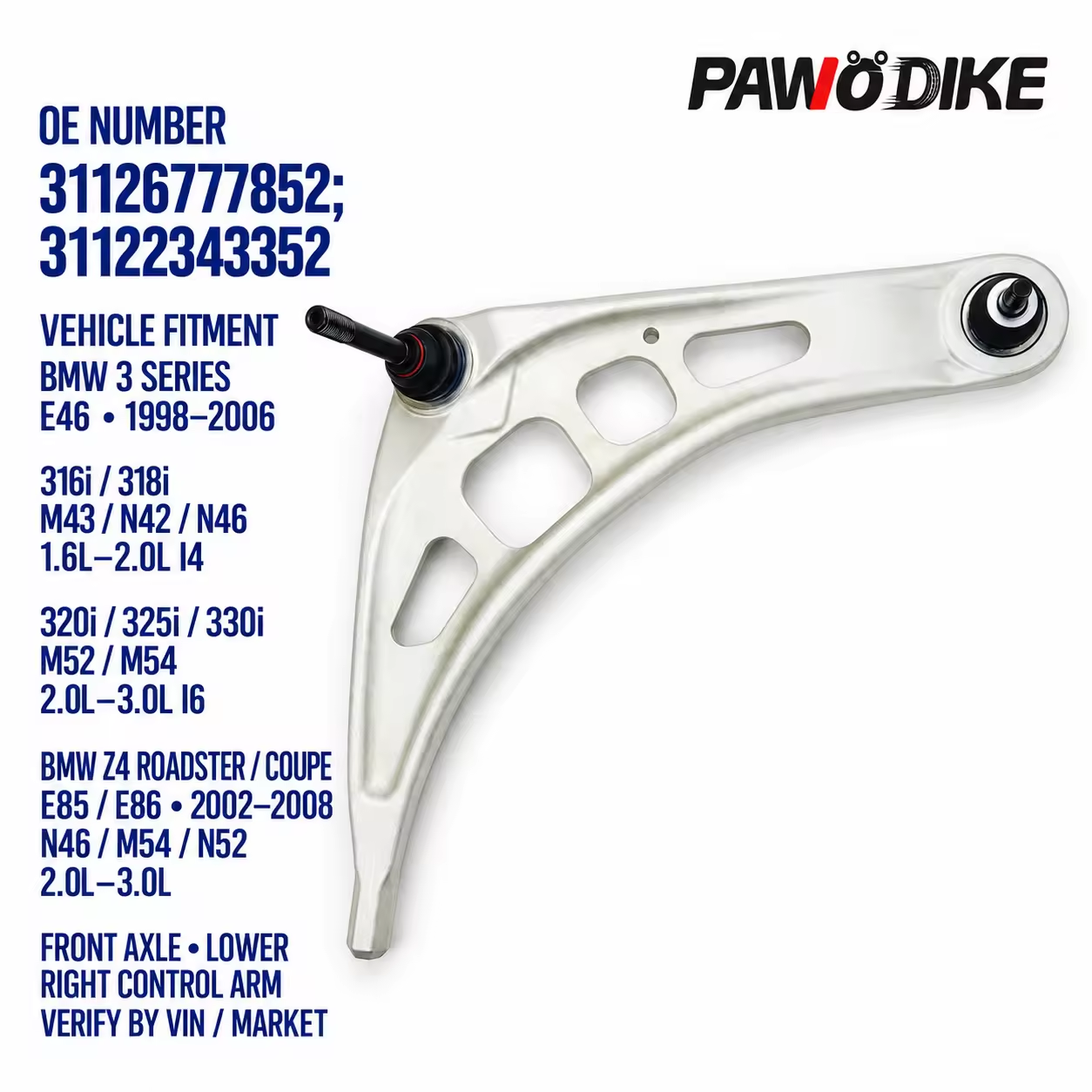
| Control Arm for BMW 3 Series (E46) | 31126777852 | Lower | 31126774826 | 2 rows: E46 1998 – 2006 + E60 2003 – 2010 | 8 rows, no E46 row |
| Control Arm for BMW 3 Series (E46) | 31126752717 | Lower | — | 1 row: E46 1998 – 2006 | 8 rows, no E46 row |
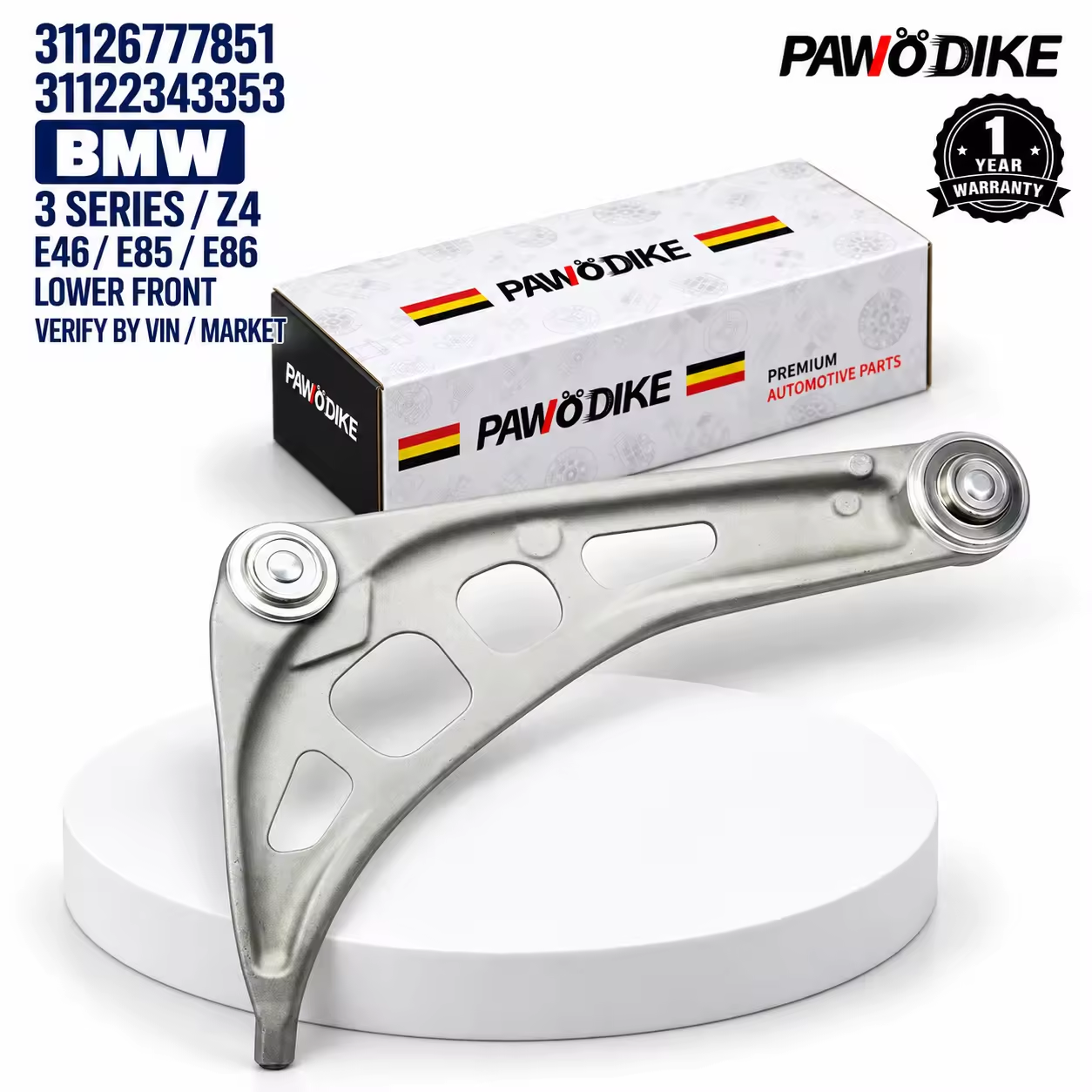
| Lower Suspension Arm for BMW 3 Series (E46) | 31126777851 | Lower | — | 1 row: E46 1998 – 2006 | 8 rows, no E46 row |
Name, OE number, fitting position, also replaces and Fits block are reproduced verbatim from the product pages (read 2026-11-20); the compatibility column gives row counts and coverage — the rows themselves sit on the product pages. Fitment is decided by the Fits block; the table is reference — the rule is set out in chapter 5.
The table hides a trap: rows two and three carry the same name — Control Arm for BMW 3 Series (E46) — yet they are two pages and two numbers (31126777852 and 31126752717). On this site the name is a first filter only; name collisions are not rare. The one thing that tells the items apart is the OE number — which is why it is the primary key: search, compare and order against the number, and the name may slip your mind. Write the number as an unbroken 11-digit string, no spaces, no letter prefix — that is the format of the product pages and of the cross-reference tool.
The field cards read in a fixed order; each field answers one question: the OE number "which item"; the fitting position "on which level"; also replaces "which other numbers"; the Fits block "for which chassis"; the compatibility table "what the supporting evidence looks like". One pass left to right and the item is fully described — four passes, then match the number on your plate.
The 7939 is the only Front item of the four and the only cross-chassis one: the name lists five codes, the Fits block lists five rows (E46/E65/E66/E63/E64, each with years), and the compatibility table runs to 107 rows across Series 5/6/7. Name, Fits block and table agree — items like this order in one go: one number, five generations. Cross-chassis or not, the ordering rule stays the same: driving an E46, read the year range of the E46 row in the Fits block; the other four rows belong to the drivers of the other chassis.
The 7852 has two particularities. One, the product page states "Also replaces" 31126774826 (the German page labels the field «Ersetzt auch»); two, the Fits block holds more than one row — alongside E46 1998 – 2006 it lists BMW 5 Series (E60) 2003 – 2010. An E60 owner landing on this item need not suspect a mis-filed page; the Fits block decides. The other way round, an E46 owner need not skip the item over the extra E60 row.
The 52717, the 7851 and the 7852 sit side by side: on the E46 their Fits blocks are identical, and the product pages state no design difference and no model-year boundary. The site draws no such line — matching the plate number of the old part beats any year-based guess and saves a return.
One more note on the German side: the same item is titled «Querlenker für BMW 3er (E46) — 31126777852» on the German product page, with field labels «Ersetzt auch» and «Einbauposition: Unten». Two pairs are enough as a memory hook: Fitting position is Einbauposition, Also replaces is Ersetzt auch — same meaning, values in the language of the page (Lower in English, Unten in German, one and the same thing). A reader moving between article and product page stays inside the same terms.
Left or right: the listing does not say, the number does
The 7851 and the 7852 end in neighbouring digits; they are two different numbers, not two spellings of one part. Wrong control-arm orders on the E46 mostly come down to that one digit: the arm arrives, does not fit or sits in the wrong place, a return follows, and the bay time is gone with it. The two sides look alike, the packing list differs by one digit, and eyes slip over it at goods-in — which is why the check after arrival stays in.
What the site can and cannot tell you has a clean boundary. It can: the position level — Front or Lower; the replacement relations — «Ersetzt auch» and the cross-reference family. It cannot: the side. The product pages carry no links/rechts; that is not a gap but the site's standing rule — the side is not decided by the listing, it is decided by the old part in your hand.
The hard evidence for the side is the number on the old part. The arm you took off (or its packaging label) carries an 11-digit number; check it against the four-item whitelist and order the match. Left and right resolve themselves in that step: number right, side right — the two numbers belong to the two sides in the first place. This text does not state which number is which side; the site does not say so, and writing it would be inventing.
Beyond the number, three photos: the plate close-up, the whole part, the bushing and ball-joint ends. The plate pins down the number, the full shot pins down type and position, the end shot rules out supply differences of the "number right, shape wrong" kind. The quote request takes the three photos together with the VIN; the site checks against the actual part and confirms before dispatch.
Three practical notes on the photos: on the plate, square the characters to the frame and avoid reflections — blurred digits do not count. On the full shot, lay the part flat and get both ends in — the commonest left/right shape difference sits at the joint end, and a complete full shot gives the site a basis for checking the side. On the end shot, go close: threads, circlip seat and stud shape count as captured when they read clearly.
A part already scrapped, or a plate worn blank, is not a dead end either. Ranked by reliability: the packaging label (the original box often keeps the number), old order or invoice records, photos taken before removal. If none of the three is there, the route is a VIN plus position description through the quote form — a step slower, and steadier than ordering a guessed number.
The typical wrong path, replayed from the start: reason from "the car is a 2003", pick a plausible row in the compatibility table, order the 7852 — the plate on the car says 7851. The three lines of defence — plate, photos, VIN — sit with you, not with the guessing.
Reading the side off the product photo is the next common mistake. The photos carry no side marking, and the viewpoint is not fixed — a photo carries appearance, not left or right. The side comes from the number, not from the image; same rule as before: the listing does not mark the side, and neither does the photo.
Interchange families and the cross-reference: the five-member family of 31126777851
Part and number are not one-to-one either. The «Ersetzt auch» field on the product page is the share the site declares itself; the full family sits in the cross-reference tool, whose input box takes OE numbers. For the four E46 items, the four queries were run:
- Query 31126777939 → single-member family: the number itself.
- Query 31126777852 → two-member family: 31126777852, 31126774826 — matching «Ersetzt auch» on the product page.
- Query 31126752717 → single-member family: the number itself.
- Query 31126777851 → five-member family: 31126777851, 31126760181, 31126770849, 31126774825, 31126854727.
The members of the five-strong family exist physically on the site: on in-stock items of the E36, E60 and E90 chassis these numbers can be found. But the family is a supply relation — the supplier ships against this set of interchange numbers; it is not a fitment claim — an E46 owner does not bolt on an E36 arm because of it. Fitment reads from each item's own Fits block; the family has exactly one job: to find you more orderable entries.
The four results also set up a contrast: the 7852's page declares one replacement number, and its family is exactly those two; the 7851's page declares none, and its family runs to five. Whether the page writes «Ersetzt auch» says nothing about family size — the declaration is the site's selection, the family is queried. To see who else a number connects to, query the tool; do not count the fields.
The forward use is the commonest: the plate reads 31126760181, site search has no page carrying that number — the "not in stock" verdict comes too soon. The cross-reference query points to the family and thus to 31126777851, whose product page is in stock. The other numbers of the five (31126770849, 31126774825, 31126854727) land on in-stock items the same way — no page does not mean no stock, and on the E46 this script is ready-made. The no-match lesson read backwards: family first, verdict second.
If the query really returns nothing (the page reports no match), check the look-alike positions first: O and 0, I and 1, B and 8 are the frequent slips in copying and in OCR; after two clean re-entries with no hit, the quote form with the VIN remains. In an unbroken 11-digit number a wrong digit is common, the eye misses it, and a digit-by-digit check against the source is the fastest way out. The full method for reading numbers and handling no-match is in the part-numbers guide and is not repeated here.
Noise rows in the compatibility table: the Fits block decides
Each product page also carries a compatibility table titled, verbatim, "Compatibility table (as supplied by the listing)" — reproduced as the supplier's listing gave it; the site notes reproduced as supplied and its reference status. It does not carry the fitment confirmation; that sits in the "Fits these vehicles" block above it. The E46 items demonstrate the point unusually well.
The three Lower items (7852, 52717, 7851) have eight table rows each, and not one of them is an E46. The earliest reaches "BMW 3 1982.09-1991.12 315 (55KW,75PS)"; the latest reach "BMW 3 Touring 2024.07 – present M3 Competition xDrive (390KW,530PS)" and "BMW 4 Coupe 2024.07 – present M4 CS xDrive (405KW,551PS)". A 1982 315 and a 2024 M3 cannot be E46 fitment records, while the Fits block plainly lists E46 1998 – 2006. When the two clash, the Fits block wins. These rows are quoted verbatim in context so you can see what a noisy table sounds like — on the next part you will recognise the pattern again.
The 7939 shows the other face: 107 rows across Series 5/6/7, matching the five codes in the name. When name, Fits block and table agree, the table is useful side evidence; when they do not, it steps back to reference. The standard stays the same: the Fits block carries the confirmation, the table does not.
The difference between tables shows plainly in this batch too: same as-supplied reproduction, yet 107 rows for the 7939 and eight each for the rest — data quality follows the supplier's listing, item by item, with no pattern to lean on. So the fixed reading order on a product page is Fits block first, table second: the one short, stable, confirmatory; the other long, uneven, side evidence only. Read the other way, the eight noise rows pull you off course.
The same day's list of the E46 chassis page doubles as a map (table 2): having found the control arm, you also see what else this chassis holds. Snapshot terms: stock moves after that date follow the chassis page, and the control-arms category carries the site-wide pagination.
| Category | In-stock item (name verbatim, slug in brackets) | Chassis coverage |
|---|---|---|
| Control arm | Control Arm for BMW (E46 / E65 / E66 / E63 / E64) (control-arm-e46) | E46 / E65 / E66 / E63 / E64 |
| Control arm | Control Arm for BMW 3 Series (E46) (control-arm-e46-2) | E46 / E60 |
| Control arm | Control Arm for BMW 3 Series (E46) (control-arm-e46-3) | E46 |
| Control arm | Lower Suspension Arm for BMW 3 Series (E46) (lower-suspension-arm-e46) | E46 |
| Shock absorber | Shock Absorber for BMW 3 Series (E46) (shock-absorber-e46) | E46 |
| Shock absorber | Shock Absorber for BMW 3 Series (E46) (shock-absorber-e46-2) | E46 |
| Tie rod | Tie Rod for BMW 3 Series (E46) (tie-rod-e46) | E46 |
| Hub unit bearing | Hub Unit Bearing for BMW 3 Series (E36 / E46) (hub-unit-bearing-e36-2) | E36 / E46 |
| Hub unit bearing | Hub Unit Bearing for BMW (E36 / E38 / E46 / E83) (hub-unit-bearing-e36) | E36 / E38 / E46 / E83 |
| Wheel hub | Wheel Hub for BMW (E36 / E38 / E46 / E60 / E61 / E63 / E64) (wheel-hub-e36) | E36 / E38 / E46 / E60 / E61 / E63 / E64 |
| Strut mount | Suspension Strut Mount for BMW 3 Series (E36 / E46) (suspension-strut-mount-e36) | E36 / E46 |
Names and coverage reproduce the stock list of the E46 chassis page of 2026-11-20 (19 items; the eleven suspension items here). Fitment is decided by each product page's Fits block — this table is navigation, not a fitment record.
The remaining eight items in one sentence: six oil filter housings (Oil Filter Housing for BMW (E46 / E60)), one heater control valve (Heater Control Valve for BMW (E39 / E46 / E83)) and one evaporator (Evaporator for BMW (E36 / E46 / E83)) — engine and climate side, off this article's path, listed so the map is complete. The map has a second use: cross-chassis parts are not a control-arm monopoly — bearings, hubs and strut mounts also reach E36/E38/E83/E60. Shared parts between the E46 and its neighbour generations are ordinary; "enter by chassis, settle by number" works in those categories just the same.
The final check before you order a control arm
- 01Plate number of the old part: the 11 digits against the four-item whitelist first; on a miss, query the family in the cross-reference tool and come back.
- 02Position and side: the position level (Front/Lower) against the plate; the side is not inferred — the number picks the item, the photo picks the side.
- 03Three photos: plate close-up, whole part, bushing and ball-joint ends — none missing.
- 04VIN: sent with the quote; the site re-checks against the VIN before dispatch.
Each of the four checks blocks a different error: the plate blocks "same name, different number" (rows two and three are the running example); the position level blocks the wrong level; the photos block "number right, shape wrong"; the VIN blocks the fitment boundary. The first three sit with you; the fourth is the site's, before dispatch — four lines passed, and the ordered number is the one that matches the plate.
"Same car, same part" does not count as an inference. Two cars of one generation, one year, one specification can carry different control-arm numbers — do not order your arm on the neighbour's number; if it does work, that is because that car happens to carry the same number, and the proof is the same: the plate of that car. The VIN stands last in the row for the same reason: it is the cross-check, not the first evidence; the first evidence is the plate.
After arrival there is half a step left: check the plate number of the delivered part before fitting. Number right — fit it; number wrong — report at once and return; a fitted part is handled on different terms. The side-by-side lay-down is the last visual check: old and new in the same orientation, bushing bores, ball-joint direction and arm length matched one for one — everything matching, then pick up the tools.
On the whole, the E46 control arm runs easy: four items in stock, fields complete, family relations clear. The trouble concentrates on the one question, left or right — and its answer sits on the plate of the old part. One clear photo of it beats any rule of thumb.
Common questions
- Welcher Querlenker ist beim E46 links, welcher rechts?
- The listing does not mark the side: 31126777851 and 31126777852 are two different numbers, and the fitting-position field reaches only the Front/Lower level. The side is settled by the old part's plate number plus three photos (the routine in chapter 3), not by inference.
- Was ist der Unterschied zwischen 31126752717 und 31126777851/7852?
- Three items sit side by side with identical Fits blocks on the E46 (BMW 3 Series (E46) 1998 – 2006; the 7852 adds E60 2003 – 2010); the product pages state no design difference or model-year boundary. The plate number of the old part decides.
- Ersetzt 31126777851 auch Nummern anderer Baureihen?
- The cross-reference query returned a five-member family: 31126777851, 31126760181, 31126770849, 31126774825, 31126854727; the members sit on in-stock items of the E36/E60/E90 side. The family is a supply relation; fitment reads from each item's own Fits block.
- Was heißt «Ersetzt auch 31126774826»?
- The replacement number stated on the product page of the 31126777852, matching the two-member family from the query. Both forms are valid as input and lead to the same item.
- Passen E36-Querlenker auch an den E46?
- Not inferred: each item's fitment statement lives in its own Fits block — the four E46 items in stock list BMW 3 Series (E46) 1998 – 2006. Cross-chassis fitment goes by Fits block plus VIN, not by the family.
Got a part number or a VIN? Get availability and price — we reply within four business hours with price and lead time attached.