


What you type into the search box is control arm; what sits on the shelf may be a Control Arm, a Suspension Arm, a Wishbone Arm, or something with no arm anywhere in the name — a Traction Rod, or a Cross Support. One category of parts, three vocabularies that do not line up: a phrase in the buyer's mouth, ten names on the listings, a plain number on the order. The control arm category on this site holds 301 listings (a full read on 22 November 2026, thirteen pages, deduplicated), and this guide lines the three vocabularies up — what the names say, which row carries the position, what the numbers look like — before closing with a map for finding the part by chassis. The house convention applies throughout: each figure and quotation comes from the day's read of the live catalogue, noise is reproduced as supplied, and nothing is settled on the supplier's behalf.
First, what this guide does and does not do. It does: lay out the naming counts and patterns, point you to where the position information actually lives, read the two number formats properly, separate the noise block from the curated block on the product page, and thread it into one path from search word to order. It does not: decide which arm on your car has failed — that takes a lift and an inspection, not an article; answer supply details the listing names and fields do not carry; predict arrivals for any chassis. If you repair cars or buy parts, what you should take from this page is a method and a map; the judgement stays with you, and the verification stays with the number.
What the listing names actually say
The counts first. Of the 301 listings, 230 are named Control Arm — about three quarters, the pattern this category runs on. Then come Suspension Arm at 22, Wishbone Arm at 20, Lower Suspension Arm at 17, Upper Suspension Arm at 4, Traction Rod at 3 and Control Link Arm at 2, with Camber Arm, Straight Arm and Cross Support at one each. Ten names for one family of parts. The boundaries between them are not drawn by this site — Wishbone and Control Arm point at each other across supplier catalogues, and a Traction Rod counts as an arm family part in some of them — so the counts are reproduced here without merging and without explaining any supplier's choice of word.
The naming follows a formula: {part type} for {brand} ({chassis}). Control Arm for Mercedes-Benz C-Class (W204) is one listing; Lower Suspension Arm for BMW (G30 / G31 / G38) is another. Inside the brackets, most entries carry a single chassis code, a fair number carry a group — F20 / F21 / F22 / F23 / F30 / F31 / F32, seven codes on one listing, or E60 / E61 / E63 / E64 / E65 / E66, six on another — where a group means the supplier declares this one arm to cover the chassis listed, and the order is still verified by number. A few names carry a model instead of a code: the MINI Countryman and Land Rover Defender listings are the two here. By brand, Mercedes-Benz takes 144 listings, BMW 130, MINI 10 and Land Rover 17 — four brands on one naming formula, the difference being only what sits in the brackets: a code, a group, or a model name.
Table 1 The ten naming patterns with the day's counts. Figures come from the full read of the category's thirteen pages on 22 November 2026, deduplicated and counted on the stretch of the name before the for; the notes column records only what the name itself states.
| Pattern in the name | Listings | Notes |
|---|---|---|
| Control Arm | 230 | The pattern about three quarters of the category runs on |
| Suspension Arm | 22 | Carries no up/down word |
| Wishbone Arm | 20 | The forked-arm pattern, one MINI Countryman among them |
| Lower Suspension Arm | 17 | An explicit "lower"; the nearest name to the search phrase lower control arm |
| Upper Suspension Arm | 4 | An explicit "upper"; F01 / F02, W164 / W251, W205 and Defender, one each |
| Traction Rod | 3 | The rod pattern, in the W204 group |
| Control Link Arm | 2 | — |
| Camber Arm | 1 | — |
| Straight Arm | 1 | — |
| Cross Support | 1 | — |
One more layer, stated as it stands: 25 listings carry "chassis to be confirmed" in the name. The part is on the shelf, the photo and the number are there, and the chassis field waits for a VIN. The right move on these is not to walk past but to ask by number: read the number off the listing page, send the VIN with it, and let a person fill the chassis in before the order is discussed. Another stretch of names carries grouped chassis, and the boundary of a group is likewise verified by number — the group is the supplier's wording, not a judgement this site makes for you. One sentence runs through the whole page: read the number, not the name.
Grouped chassis deserve two more sentences, because they read easiest as "fits anything". A group of seven codes from F20 to F32 says the supplier declares this one arm to cover those seven sub-chassis — the corresponding 1, 2, 3 and 4 Series bodies — but the boundary hides inside the number and the model year: an early build and a late build inside one group may have taken different arms, and four-wheel drive may split from rear drive. So a group is for narrowing, not for concluding: your code sits in the group, the listing becomes a candidate; before ordering you still check your old number against the OE field, and a mismatch sends you back to the enquiry. And if your code sits in none of the groups, that does not mean no stock — 301 is the day's shelf count, the number library behind the counter is wider than the shelf, and a number asked for gets looked up.
Upper, lower, front, rear: where the position really lives
Up, down, left, right, front, rear — those six words live in two rows on the product page: one called Fitting position, one called Position, the two agreeing with each other. The values observed in the day's sampling run to four: Right, Front, Upper and Lower. The W204 Control Arm page carries Right in both rows; the W205 Lower Suspension Arm page carries Front; the F01 Upper Suspension Arm page carries Upper. The home of the position information is the field, not the name: only 21 names carry an explicit Upper or Lower, and for the other 280 listings the position lives in these two rows on the product page. Someone searching lower control arm should not hunt for the word "lower" in the names — open the product page and read the field.
There is one noise instance worth reproducing untouched. The W164 / W251 Upper Suspension Arm: the name says upper, and the Fitting position row on the product page reads "Lower." — name and field contradict each other on the same page. The site's handling is to place the two side by side as supplied and reconcile nothing, because that is how the source data arrived; the page does not take the supplier's side either. The buyer works the same way: do not rule on which side is right, take the OE number plus the VIN and verify, and order once the check comes back. Contradictions of this kind are not rare in supplier data — the name and the field come from two entries, and a slip survives — and the answer to them is the number, not a guess.
Left and right as a pair is another thing the name does not settle. The W204 Control Arm's position row reads Right — one side only; whether the left side shares the number, mirrors it, or sits in another number run, the field does not say, and across brands the usual practice is one number per side. Replacing one side, you copy the number off that side's old arm; replacing both, you copy both numbers and write them on two lines. The alignment check after the work stands as usual — suspension parts have moved, and the toe and camber go back inside spec before the car is returned, the line this site's air suspension guide already carries for struts. A control arm is not exempt.
Empty fields are a further case. On the odd page the Fitting position and Position rows sit blank — the field was left unfilled. This is the same class of problem as the contradiction above: in data reproduced as supplied, a field can be filled wrongly or left empty, and an empty value is not a verdict of "no position", only the fact that this page does not say. The move on an empty page does not change: copy the number, send the VIN, and let the position be filled in during the human check. Reading an empty as a negative, and reading a wrong entry as the truth, are two faces of the same mistake.
Control arm bushing: what a bushing search finds here
Where the four search phrases land, in one paragraph. Control arm: hits the leading pattern — 230 Control Arm listings plus the Suspension Arm and Wishbone Arm names without a direction word — searchable directly, openable directly. Lower control arm: the 17 explicit Lower Suspension Arm listings, and then a large share of arms that are in fact lower arms but are named Control Arm — the word under-searches, the position row completes it. Control arm bushing and lower control arm bushing: zero landing at the name level, the need goes down the number-plus-VIN enquiry path. Four phrases, three fates — direct hit, half hit, no hit — and that is what "three vocabularies" means at the ordering step, and why this guide puts the position row and the number formats ahead of any name-by-name comparison.
Put the phrase control arm bushing into this category and the result is zero: across 301 listing names, the word bushing appears zero times. The category stocks arms, not bushings — a Lower Suspension Arm is the lower arm, not the lower arm's bushing — and the phrase lower control arm bushing finds no landing at the name level either. That is a convention, not a verdict on stock: in what form a bushing is supplied — on its own, with the arm, pressed in — neither the names nor the fields say, and this guide does not answer for the supplier. The search volume sits in the planning (control arm bushing at an estimated 8,100 a month, lower control arm bushing at 3,600, both US phrases); the demand is real, and what receives it is not the name but the path below.
The path for a bushing need is therefore clear: the number comes off the old part or the car. The number pressed into the old bushing, or the original arm's number together with the bushing position (front left, front right, that vocabulary), plus the VIN, goes to the enquiry; for a lower-arm bushing, send the lower control arm number and the bushing position together and let a person confirm the supply form before the order stands. This is the same construction as the air suspension guide on this site — where the word fails to find the part, the number finds it. The word is the entrance, the number is the destination, and between the two sits one human confirmation — the very step that keeps the wrong part out of the box.
The numbers: an A and ten digits, or eleven digits
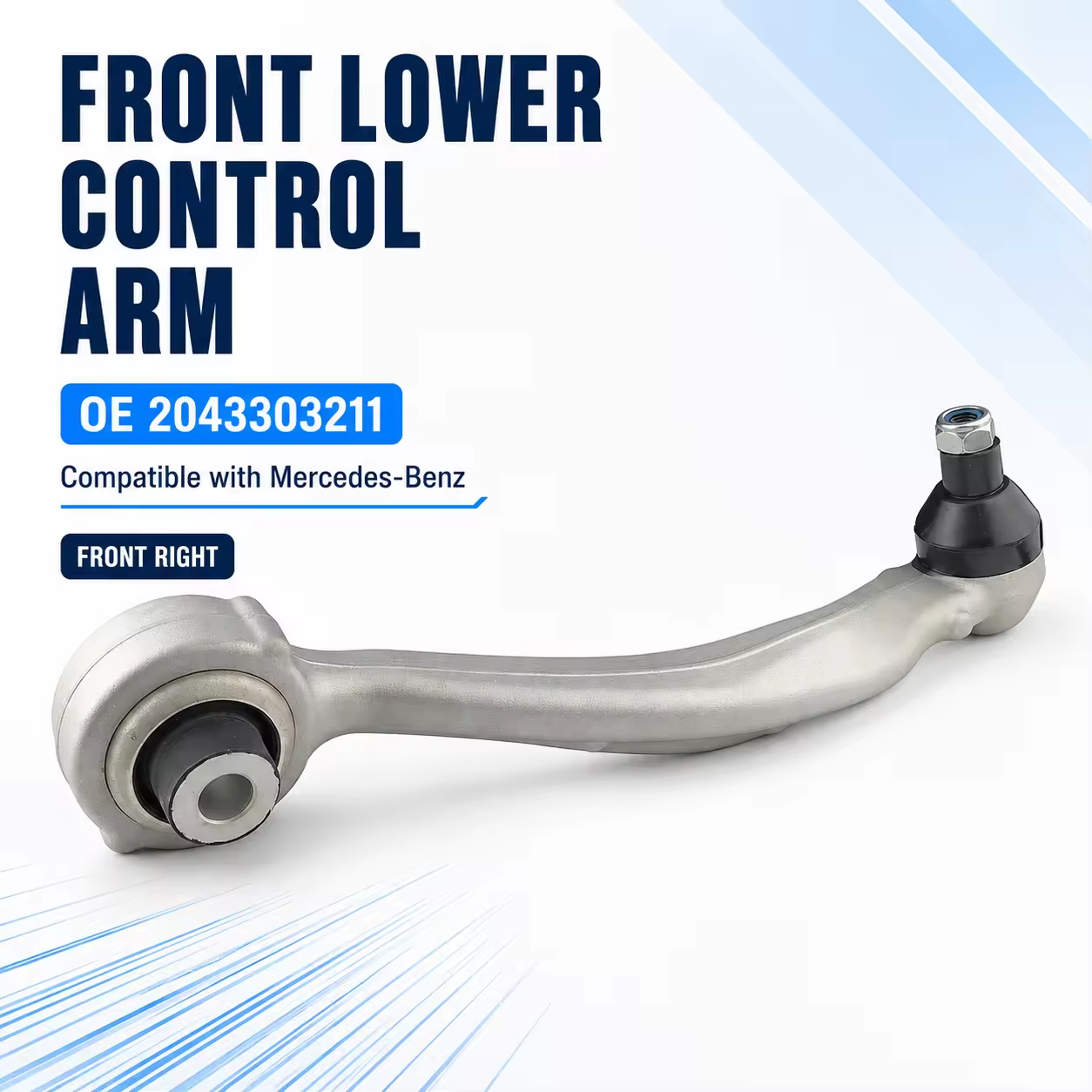
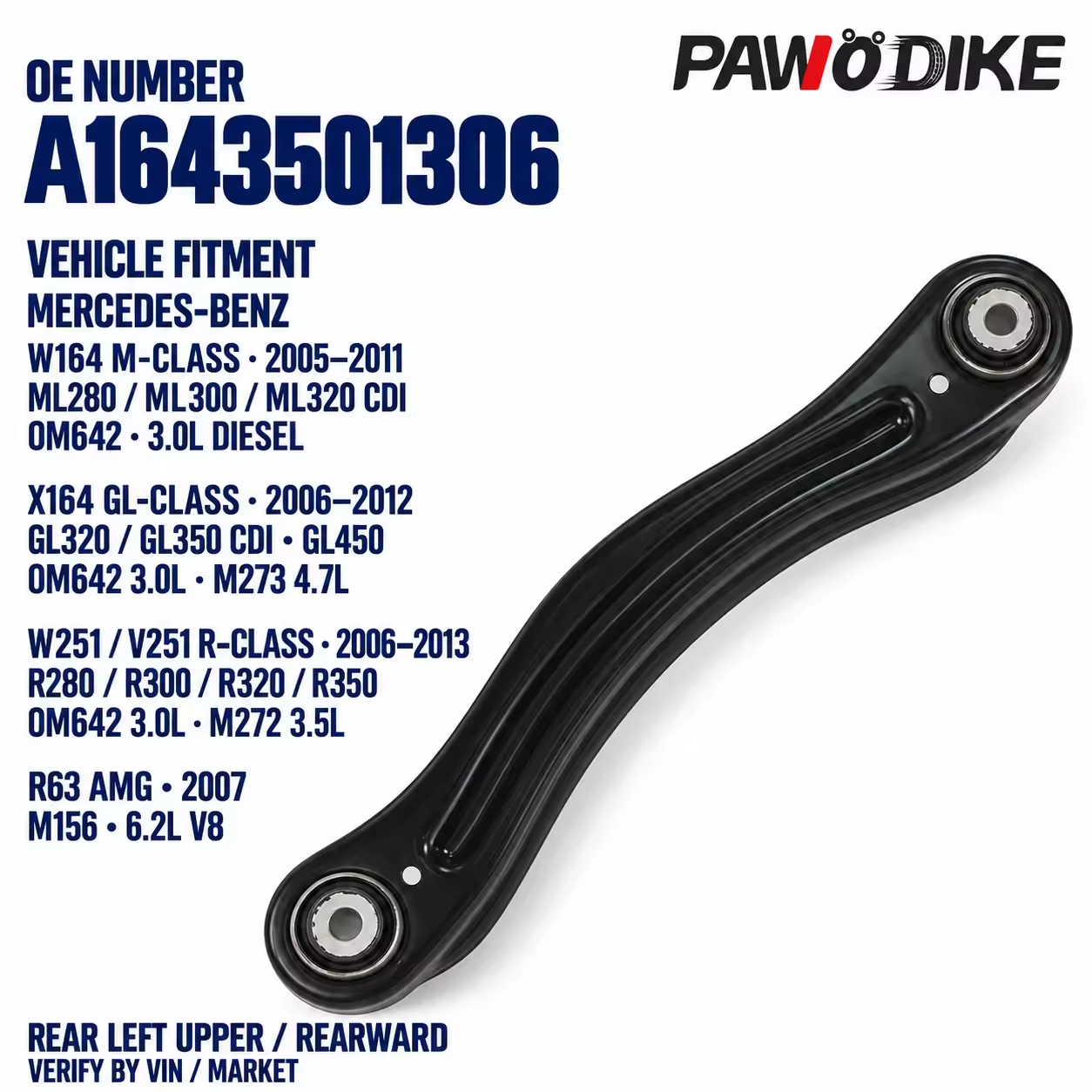
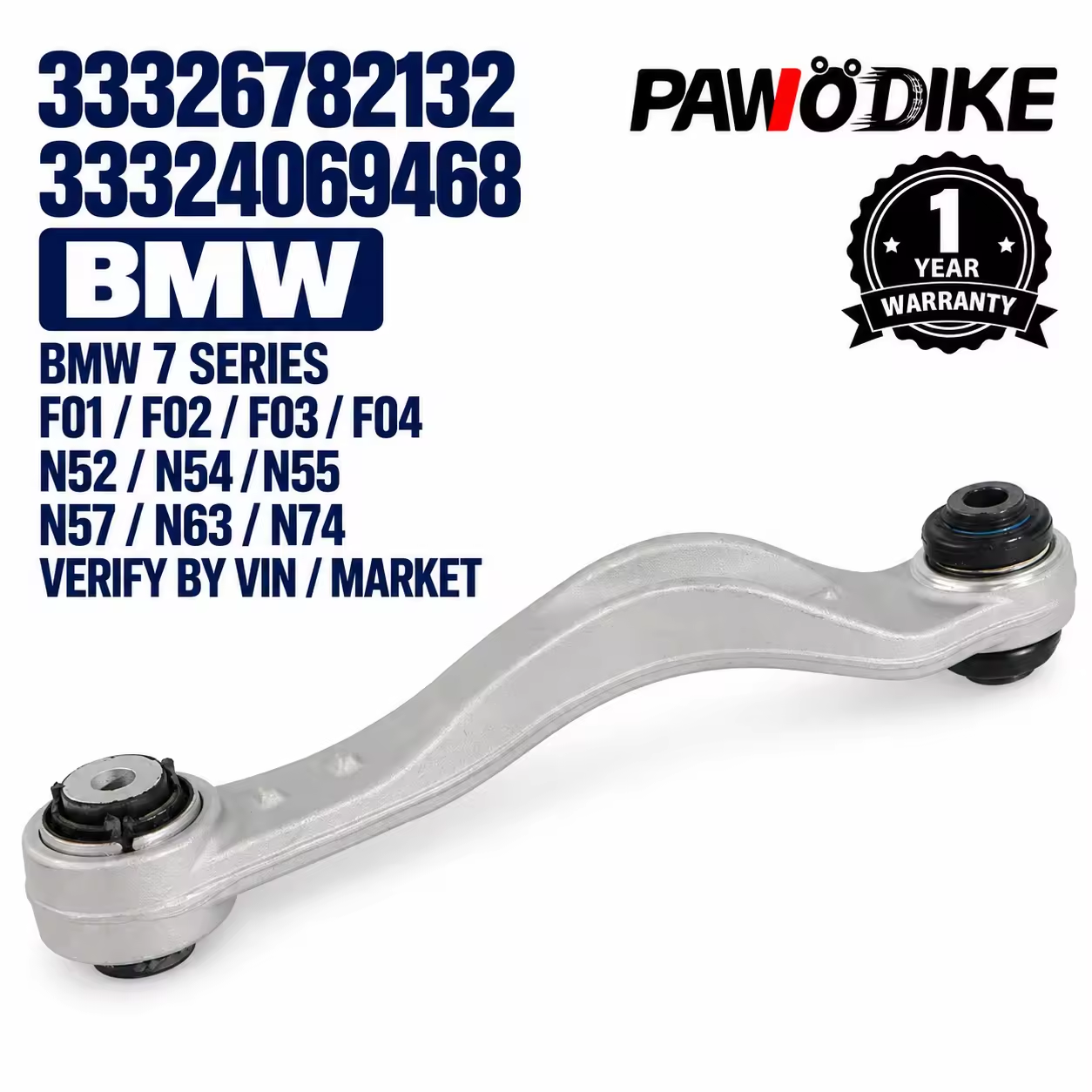
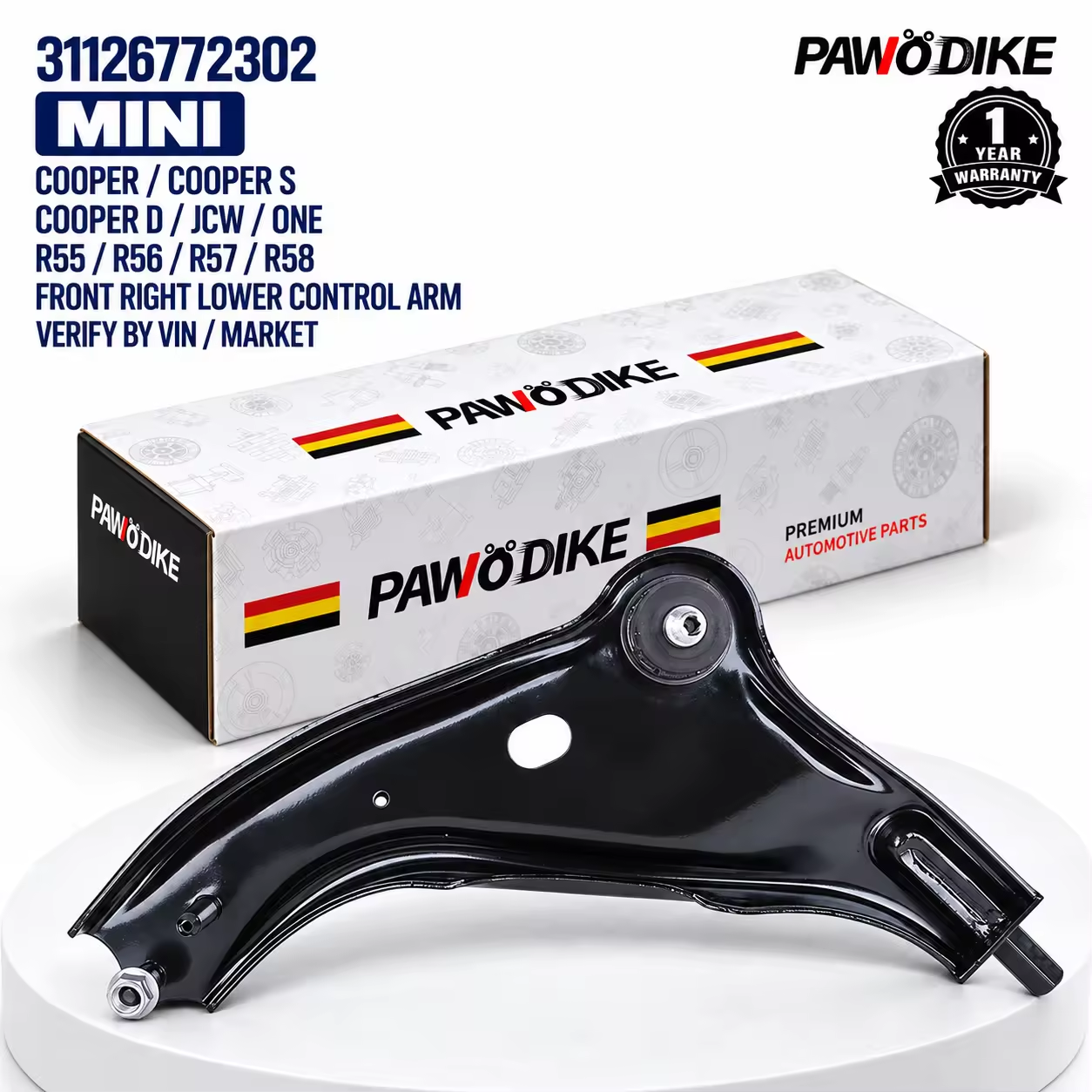
The two brands wear two number shapes. A Mercedes-Benz number is an A followed by ten digits: A2053301805, A1643501306; the bare ten-digit spelling without the leading A also runs through the listings — 2043303211 is the bare form of the same number with its A-prefix on, two spellings of one number, one meaning. A BMW or MINI number is eleven digits with no letter: 33326782132, 31126772302. The MINI number is the BMW format — 31126772302 is the number on that MINI R55 / R56 / R57 / R58 Control Arm; the details of the shared number ground are laid out in this site's MINI article, and one sentence suffices here: an eleven-digit bare number reads first as BMW / MINI format.
On the product page the OE, sku and mpn fields settle on one number, and that alignment is the verification point: the number copied off the old part matches the number on the listing, and the part matches. One line on the page deserves quoting verbatim: "Chassis range derived from the OE part-number prefix." — the chassis range is derived from the prefix of the number. The 204 at the head of 2043303211 points at W204; the 205 behind the A of A2053301805 points at W205; the 333 opening 33326782132 is the BMW run's habit. The prefix carries the chassis inside the number itself, and that is the root of why the number outlives the name: names get rewritten, translated, mismatched — the number is stamped on the part and stays.
Finding the number on the old arm is a plain set of moves. Wipe the oil film and the rust off the plate area first — the number is usually stamped or cast into a flat stretch of the arm, the casting is shallow, and dirt blurs it. Then copy the number whole: no shortening, no filling in from memory, because each position in the number carries meaning and one digit off is another part. Then two photographs — one close-up of the plate, one of the whole arm — the close-up for checking, the whole-arm shot for a person to compare the form. Where the legend is unreadable — rust, wear, paint — do not guess: send the VIN and let the vehicle side be worked back from. Two extra minutes at the copying step against a two-week exchange cycle is an easy account to settle.
One number in several spellings occurs here as well; the Mercedes pair with and without the A has already passed above. The spelling story — where the A comes from, how the positions split, how the cross-reference is used — has a guide of its own, the number-reading guide; the look-up tool is the cross-reference, and the standard form (the A-prefixed spelling at Mercedes-Benz, the full eleven digits at BMW / MINI) draws the widest hit. What stays on this page is the ordering short version: copy the number as the part wears it, search with the standard form, check against the three fields together.
The noise you will meet on the page
Two blocks of fitment information sit on the product page, one curated and one reproduced as supplied, and reading them apart matters. The curated block is called "Fits these vehicles": on the W205 lower-arm page it reads Mercedes-Benz C-Class (W205) 2014 – 2021 — chassis aligned, years clean, consistent with the name. The reproduced block is the "Compatibility table (as supplied by the listing)", which carries the supplier's sheet over as it came: on the same page, the rows that appear are GLC and GLC Coupe — 2015.09-2019.05 at 300 4-matic (190KW, 258PS), 2017.01-2019.05 at 200 4-matic (145KW, 197PS) — nothing to do with the C-Class, with the table's scale marked at 200 rows. Two blocks on one page: one worked over, one kept as it arrived.
The line the site sets beside the table deserves quoting in full: "Reproduced as supplied by the source listing, including its own wording and gaps. Reference only — it does not drive the fitment we confirm. Check “Fits these vehicles” above, or send us your VIN." — reproduced from the source listing, with its own wording and its gaps; reference only, not what drives the fitment confirmed here; see the curated block above, or send the VIN. The conclusion grows straight out of that sentence: a row in the compatibility table is not the fitment basis; the number and the VIN are. Elsewhere the page offers "Don't see your car? Send us your chassis code →" — the same logic asked another way. The noise is not an obstacle; it is a reminder that the final judge of fitment is the number, not row so-and-so of a table.
Used together, the two blocks make one complete path. The curated block does the quick cut: name, chassis and years agreeing, the candidate stands. The compatibility table supplies leads: a row that happens to match your car is material for asking, not a basis. The number and the VIN do the final ruling: copy, check the three fields, send the VIN, and the fitment is confirmed or dismissed at that step. The table stays on the page because transparency is worth more than tidiness — you can see the rough edge in the data, and you know at which step to be careful. It is the one sentence of the whole page again: each layer of information has the use it is good at, and errors come from using a layer past its level.
Ordering by chassis: the map
One entrance to the category: the control arm category, thirteen pages, 301 listings. Three ways by brand: Mercedes-Benz 144 — W204 and W205 the two heads (14 and 15 listings on the day), W222 and W221 next (12 and 11), W251 at seven, with W212, W463 and W220 each carrying listings; BMW 130 — the span runs from E36, E38, E39, E46, E53 and E60 through F01, F10, F25, E70 and E84 to G01, G05 / G06 / G07, G11 / G12, G20 / G28 and G30, with grouped-chassis listings throughout; MINI 10 — sitting on the R50 / R52 / R53, R55-R58, R60 / R61 and F55 / F56 / F57 groups; Land Rover 17 — a Defender among them and the rest largely on the to-be-confirmed list.
The two smaller brands, in passing. MINI's ten: one lower arm on R50 / R52 / R53, Control Arms spread over R55 / R56 / R57 / R58 (two listings), R60 / R61 (two), F55 / F56 / F57 and the combined R50-to-R56 group (one each), plus the Countryman Wishbone Arm and one chassis-to-be-confirmed — nine of the ten carry a chassis group, and both the fitment page and the number route reach them. Land Rover's seventeen: the Defender upper arm carries a model name and no code, the rest sit largely on the confirmed-on-ask list — number plus VIN, same as before. A small brand, the same method.
Finding by chassis runs through the fitment pages: W204, W205, W164, F01, R55, R56, F56, C118, G30 and E53 — ten pages checked online on 22 November 2026, one chassis per page, numbers and fitment gathered inside. How the codes themselves are read — the letter-and-number at Mercedes-Benz, the E / F / G eras at BMW — has a full generation table in the chassis codes guide; the air suspension hub is the same chassis map drawn over another category: fix the chassis, open the page, copy the number. Those two and this one stand as a tripod — one category each, one shared method.
The ordering run closes with four things: the number off the old part (an A and ten digits, or eleven — copied as the part wears it, nothing dropped, nothing added), the VIN (the string on the registration document or the plate), one or two photographs (the whole old part, and a close-up of the plate), and where there is a symptom, one line describing it. The number goes through the cross-reference first — the spellings collect onto the standard form there — then through the enquiry, where a person checks the chassis, the position and the supply form, and the order stands once the reply confirms it. On arrival, the number gets checked before the spanner: the number on the box, on the part and on the order — the three agreeing, the work begins. The run repeats across this site's guides because it is the path with the fewest wrong parts on it.
How the companion pieces divide the work: the number-reading guide takes the digits and the spellings; the chassis codes guide takes the codes and the generations; the air suspension hub takes the same chassis map over its own category; this page takes the control arms. Four pieces, one method — fix the chassis, copy the number, check the fields, make the enquiry — and the method is nothing rare; what is rare is doing it on each order. The part that arrives being the right one is not luck; it is this run walked to the end. You come in on a search word, you go out on an order number, and each step between has a page to check and a person to ask.

Common questions
- Control arm or lower control arm — which one do I need?
- Look at two places, not at the word: the Fitting position and Position rows on the product page, whose observed values run to Right, Front, Upper and Lower; only 21 names carry an explicit Upper or Lower, and for the other 280 listings the position lives in the fields. Copy the number off the old part, match it against the listing's OE field, and glance at the position row — the word's ambiguity dissolves in front of the number. Still unsure, send the number and the VIN for a human check.
- Do you sell control arm bushings separately?
- Across the category's 301 listing names, bushing appears zero times — the category stocks arms and lists no bushing names. In what form a bushing is supplied (on its own, with the arm, pressed in) is written in neither the names nor the fields, and this page does not answer for the supplier. The route for a bushing need: the number pressed into the old bushing, or the original arm's number with the bushing position, together with the VIN, through the enquiry.
- How do I find control arms for my car on this site?
- Three steps: fix the chassis (from the VIN or the chassis codes guide), open the matching fitment page (W204, W205, F01, R56 and the rest, ten pages online), and copy the number off the old part into the cross-reference. The search box works by number, not by word — 301 names in ten patterns make the word's hit rate unsteady, while the number's hit rate is settled. The 25 chassis-to-be-confirmed listings go the same way: ask by number.
- Why does the name say upper arm but the position says lower?
- There is a live example: the W164 / W251 Upper Suspension Arm, whose product page reads "Lower." in the Fitting position row. The site's convention is to place the two side by side as supplied and reconcile nothing, the source data being what it is; the ordering convention is the OE number plus the VIN, taking neither the name nor the field on its own authority. A contradiction of this kind ends with the number, not with a guess.
- What do OE, sku and mpn mean on the listing?
- Three fields settling on one number: OE is the original-equipment number; sku and mpn are bookkeeping names for the same number on the stock and manufacturing side. The three fields aligning is the verification point — the number off the old part matches the listing number, and the part matches. How the digits are read and where the spellings come from is laid out in the number-reading guide.
Got a part number or a VIN? Get availability and price — we reply within four business hours with price and lead time attached.