


The problem put plainly: people arrive at a part number in one of two states. Some already hold the number and want to know how to read it and what the reading is good for; others have yet to obtain one and need to settle first where the number comes from. This guide connects both routes: it covers how the number is read, and then where the number you have read goes for a lookup, and in what order to proceed when the lookup comes back empty. Publication goes by this English version, translated one to one from the Chinese text.
The terms deserve a plain statement first. An OE number is the number the vehicle manufacturer assigns to one particular component, and it is the surest way of bringing a search down to one single unit. A cross-reference is the act and the table of matching numbers from different numbering systems that point at the same part, and the group of numbers pointing at one and the same part is called a cross-reference family. A bare part number is the writing with the letter prefix removed and the digits left standing. The primary part number is the number current within a family; a superseding number is the new number issued after a design change to take the place of an older one, and the one displaced is the replaced number. The supplier's own number is the reference the factory feeding the assembly line gives the same part under its own name. The prefix, the model block, the main group code and the chassis code are the four units a number is read in, and this guide takes the Mercedes and the BMW formats in turn.
Mercedes-Benz: the prefix and the model block
A Mercedes-Benz part number is a letter prefix followed by digits, conventionally written in groups: A 205 240 42 00. You will also see it written without spaces (A2052404200) or without the prefix (2052404200). All three are the same number — the spacing is a reading aid, not data.
The prefix marks the parts family. A is the one you will see on passenger-car parts; N appears on standard hardware — fasteners, clips, seals sold to a general specification rather than to a car.
The first three digits after the prefix are the model series the part was originally released for. 205 is the W205 C-Class, 213 the W213 E-Class, 221 the W221 S-Class. This is the single most useful block to read.
The remaining digits identify the component group and then the specific variant within it.
The model block speaks only of birth: Mercedes part numbers record the series a part was born into, not the range of cars it later fits. To walk the opposite way, from the car toward its number, and map the first three digits onto a specific series code, the chassis-code guide covers that route; the gap between birthplace and fitment is what cross-referencing closes.
BMW: eleven digits, in groups of 2-2-1-3-3
BMW part numbers are eleven digits, conventionally grouped as 11 51 8 666 807. The grouping is not cosmetic — the first two digits are a main group code covering a whole system of the car.
Table 1. BMW main group codes: the first two digits. A main group code covers one whole system of the car; dozens of codes exist beyond these eight, but the eight cover most of what a workshop replaces.
| First two digits | System | Typical parts |
|---|---|---|
| 11 | Engine | Water pumps, mounts, intake ducting |
| 12 | Engine electrical | Ignition coils, spark plugs, sensors |
| 13 | Fuel and air supply | Intake ducts, injection components |
| 24 | Transmission | Oil pans, mechatronics, seals |
| 31 | Front axle | Shock absorbers, control arms |
| 33 | Rear axle | Suspension arms, subframe components |
| 61 | Body electrical | Wiper arms and blades, lighting, switches |
| 64 | Heating and air conditioning | A/C compressors, condensers |
The next pair narrows it to a sub-assembly, and the remaining digits identify the specific item and its revision. There are dozens of main groups beyond the eight above, but those eight cover most of what comes through a workshop door.
A quick sanity check on any BMW number you are given: if you have been quoted a compressor and the number starts with 64, it is plausibly an air-conditioning part. If it starts with 11, somebody has copied the wrong line off an invoice.
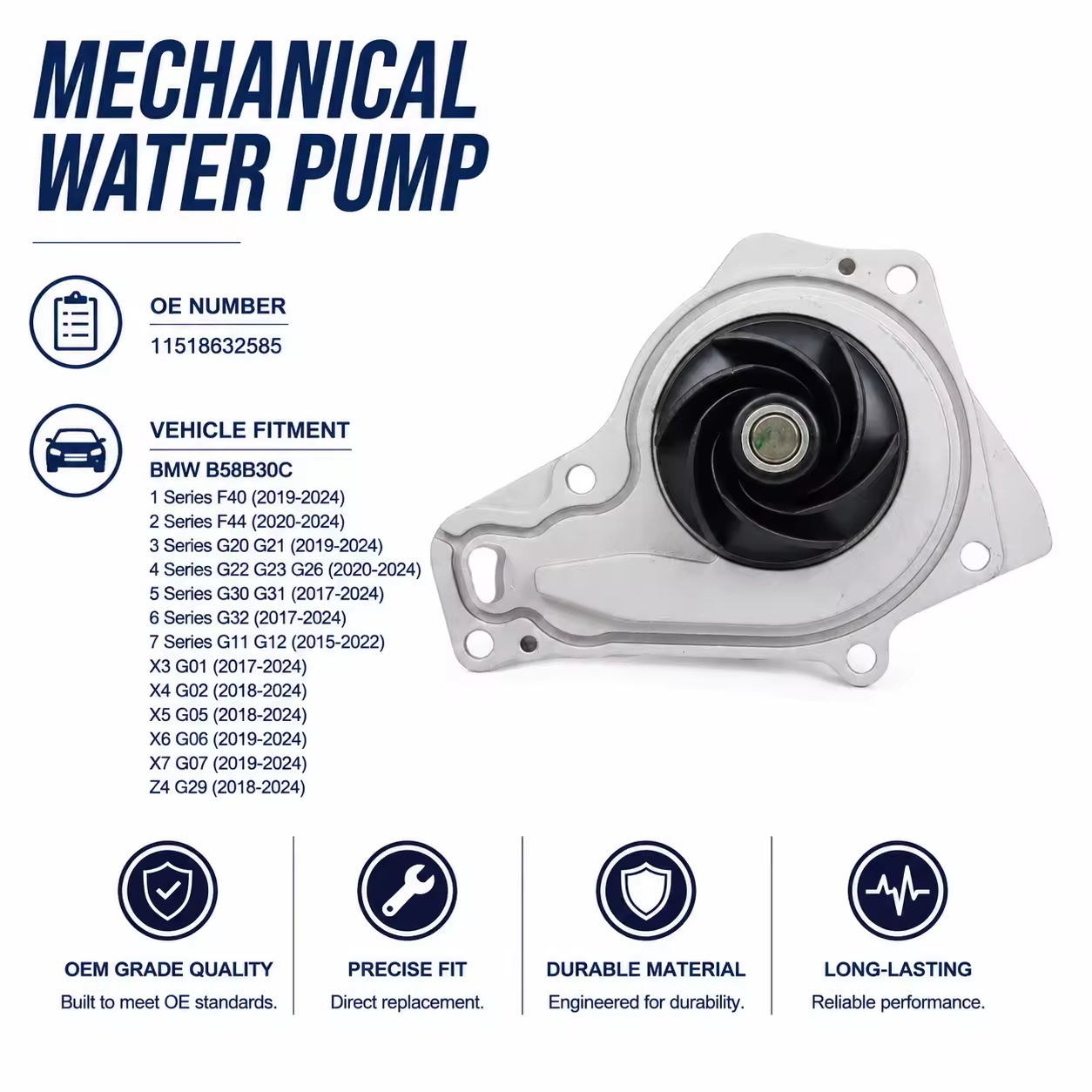
To practise the grouping on a part actually listed on this site: the BMW water pump carrying the BMW part number 11518632585 reads as 11 51 8 632 585, and the leading 11 lands it in the engine main group — squarely matching its identity as a water pump.
Why one part has three numbers
All three numbers serve for a cross-reference lookup: the original, the successor after supersession, and the supplier's own
This is the part that costs people the most money. A single component can legitimately appear under several numbers:
- 01The original number it was released under.
- 02A superseding number issued when the design changed — a different material, a revised bracket, a new supplier. The old number becomes "replaced by", and catalogues show the chain.
- 03The supplier's own number. The company that manufactured it for the assembly line also sells it in its own box, under its own reference. Same part, different number, different packaging.
None of these are fakes. They are the same component described from three directions. What matters is whether the number you are ordering has been cross-referenced against the number that belongs to *your* car, and a supplier who cannot show you that chain is guessing.
Reading the number is recognizing the three identities; looking it up is resolving the writings to one part
Reading and looking up are two separate actions. Reading settles recognition: prefix, model block and main group code tell which system the number in hand belongs to and which of the three identities it carries. The lookup settles correspondence: the prefixed writing, the bare writing and the numbers before and after supersession are resolved onto one and the same current part. What can be recognized can be matched.
A superseding number and a supplier's own number are commonly read as evidence of a fake, which gets the direction backwards. A superseding number says the part is the current version after a design change, and walking back along the replacement chain usually finds where the older number in hand came from; a supplier's own number says the part came from the factory that feeds the assembly line, and which grade of goods it corresponds to is a question the terminology guide takes up separately.
A lookup that comes back empty means neither that the part does not exist nor that the number is fake
An empty lookup is a common event, and the cause mostly lies in the writing rather than in the part itself: a digit copied wrong, a number already superseded, or a query that was not an OE number in the first place. Numbers are read digit by digit, worn stamps and hand copies both displace digits, and one digit off is a different number.
An empty result deserves no verdict yet. Run the writings through another round, and walk back along the supersession chain; if both routes end empty, hand the number to a person to confirm, and order only once it is confirmed. No match says only that the on-site catalogue does not currently carry that writing — not that the part does not exist, and still less that the number is fake.
Put the number in: how a cross-reference lookup actually runs
The on-site tool reads all three writings: the OE number, the bare number, the replaced older number
The input box of the cross-reference tool on this site states its own scope: any OE or reference number goes in, whether the site's own part number, its bare form, or one of the numbers it replaces, and each matching part comes back together with its whole cross-reference family. In other words, all three identities of a number are recognized at the input end.
Recognizing the bare number is where the convenience lies. Numbers on invoices, lists and photographs of old parts often arrive with the prefix gone and the spacing gone; a tool that reads the bare form means a copied number can be searched without restoring its prefix first. Readers starting from the vehicle side take the search by number or VIN entrance instead.
Table 2. Three writings, how the tool reads each, and the measured result. The measurements are direct queries against the on-site cross-reference tool on 2026-11-11; the numbers, labels and part names in the first two rows are taken verbatim from the result pages, and the third row, for which no example came up in testing, carries no claim.
| How the number is written | How the tool reads it | Measured result |
|---|---|---|
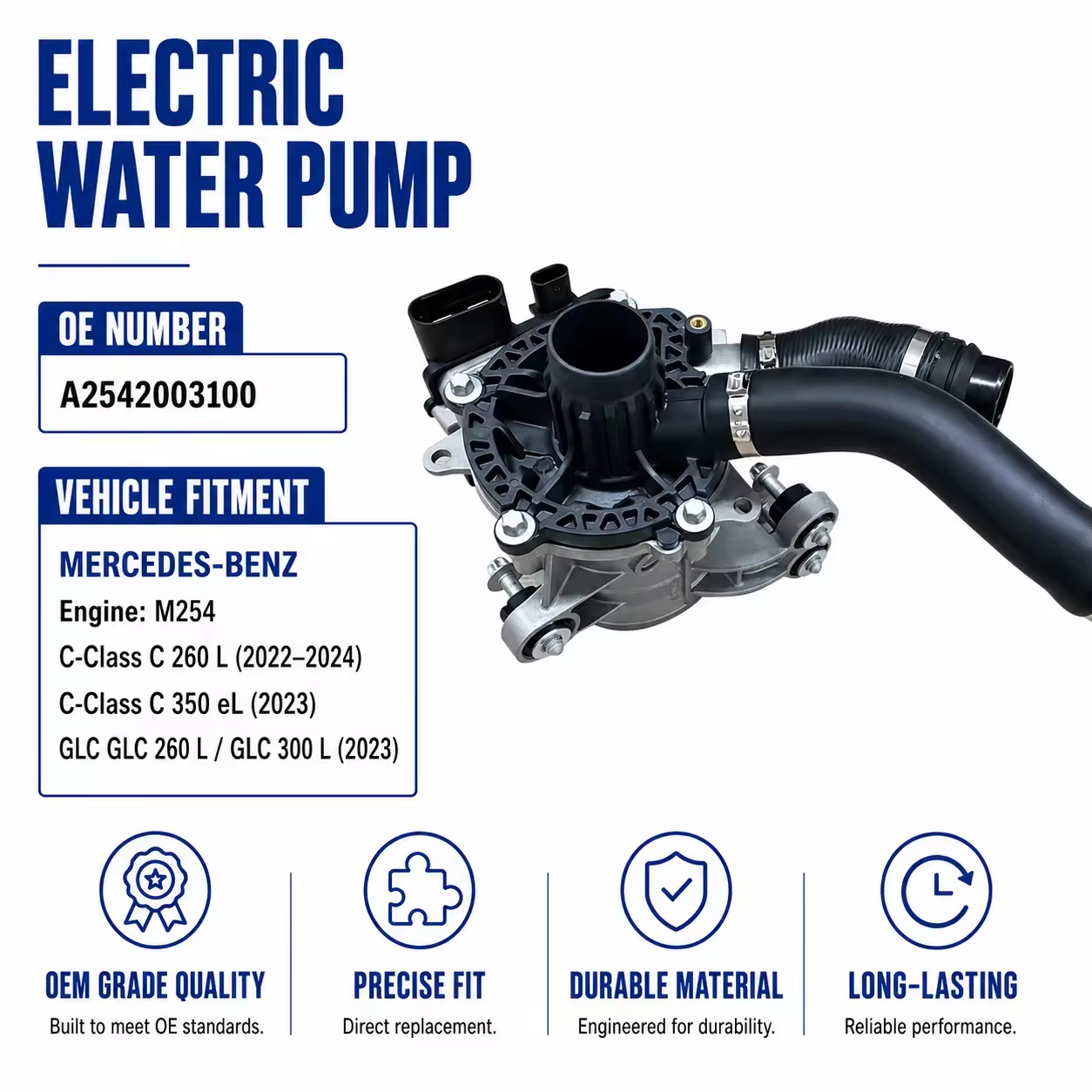
| An OE number with its prefix (e.g. A2542003100) | Primary part number | 1 matching part: Water Pump for Mercedes-Benz GLC, with the product-page entry attached |
| The bare number without its prefix (e.g. 2542003100) | Bare part number, resolved to the same part | 1 matching part: the same GLC water pump |
| An older number it replaced | The tool page states it accepts one of the numbers it replaces | Not covered by this round of seven measured queries; no claim made |
Two measured queries: the engine-mount number 2032401617 hits on the first try, and the bare number 2542003100 lands too
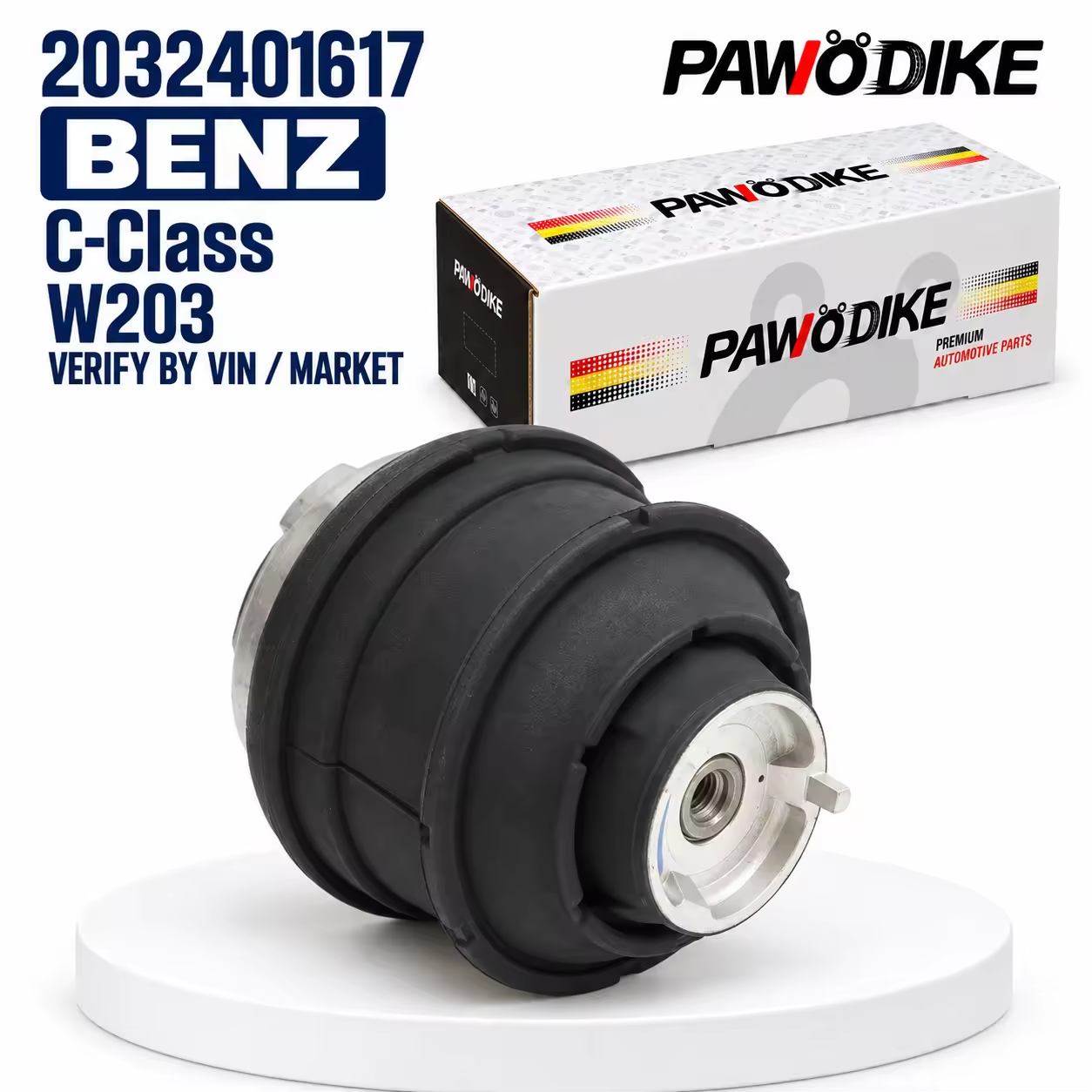
The first query looks up an engine mount: the number 2032401617 goes into the tool and returns 1 matching part, labelled Primary part number, named Engine Mount for Mercedes-Benz C-Class (W203), with the product page at its side. What a failing mount sounds like and how to judge whether it needs replacing are covered in more detail in the engine-mount guide, and the entrance by chassis is the W203 fitment page.
The second query is a Mercedes part number search in bare form: what goes in is 2542003100, without its prefix. The tool still returns 1 matching part, the label switches to Bare part number, the number it resolves to is the current primary A2542003100, and the part is named Water Pump for Mercedes-Benz GLC, again with the product page attached. What a cooling part such as a pump gives away before it fails was covered in the cooling-system guide, in the order in which things fail.
What the result page gives: the match count, the primary or bare label, the part name and the product-page entry
A hit of a result page hands over four things: the match count, the identity label on the number (primary or bare), the part name, and the product-page entry. The first two together state the number's position within the family — the current primary, or a writing to be resolved into it — and the last two connect the query straight to a part that can be ordered.
Run the same BMW part number search on the water pump listed above (11518632585) and it likewise returns 1 matching part, the primary label and the product page. The number sits in its family, and the three writings arrive at the same destination by different roads; with the lookup done properly, the number and the part name have a common landing point when the enquiry goes out.
When the lookup says no match
Three common causes of a no match: a digit copied wrong, a superseded number, a number that is not an OE number in the first place
A no match is screened against the three common causes first. One, a digit copied wrong: numbers are read digit by digit, worn stamps, hand copies and list transfers all displace digits, and one digit off is another number. Two, a superseded number: after a design change the old number is taken over by a new one, and where the on-site catalogue builds its families around the current number, the older writing can fail to appear. Three, a number that is not an OE number in the first place: a supplier's own reference or a parts distributor's internal code runs on a separate numbering system, and a no match from an OE-number tool is the normal outcome for it.
The tool page itself gives the same hint. The no-match result page states plainly that the number may be a superseded or regional variant the site lists under a different code, and invites the reader to send it in for confirmation. One measured case sits in the archive: 989e500-g01 goes into the tool and returns No match, with that hint and the manual-submission entrance in their usual places.
The routine: re-read the number off the part itself first, then try the other writing
The routine runs three steps in a fixed order: rule out a copying error first, rule out a writing problem second, and fall back to a person last.
- 01Re-read the number off the original: go back to the old part itself, the original paperwork or a photograph of the actual piece, and read it digit by digit — prefix, spacing and grouping taken from the original, not from memory.
- 02Try the other writing: query once with the prefix, once without it; once spaced, once run together. Most copying errors surface at this step.
- 03Still no match, hand it over: submit the number or the VIN for confirmation by a person, who walks the catalogue and the replacement chain; order only once it is confirmed.
The built-in fallback: send the number over, order once it is confirmed
The no-match result page carries its own fallback, on a button reading Ask us to source it: the number and the quantity go across, and the site confirms whether the number resolves to a part, and to which part. The entrance is the quote form, with the number or the VIN written out in full in a single pass.
Ordering only after confirmation saves time on both sides: the buyer does not have to guess at a number the tool could not find, and the supplier does not have to quote against a wrong one. With the lookup done properly, the enquiry finally has a landing point both sides can see.
The checklist before you order
- 01Start from the VIN or the number off the old part. Not from the model name — the same model name spans several generations with different parts.
- 02Search both forms of a Mercedes number: with and without the A prefix, spaced and unspaced.
- 03Run the number through the cross-reference tool once: the three writings resolve to one part, and the primary number, the part name and the product-page entry come back together.
- 04If the number you have is superseded, ask what replaces it and confirm the replacement is listed for your chassis code.
- 05Photograph the old part next to a ruler before you order. Numbers get copied off invoices that were themselves wrong.
- 06Give the supplier the VIN, not just the number. A VIN check catches the variant-level differences that a number alone cannot.
Send us the number or the VIN and we will confirm the match before anything ships — see how to request a quote.
Common questions
- Is the A at the front of a Mercedes part number required?
- Not always. A 205 240 42 00 and 205 240 42 00 refer to the same part in most catalogues — the A is the parts-family prefix and is frequently dropped in listings and on invoices. Search both forms before concluding a number does not exist.
- My part number has a different last two digits — is it the wrong part?
- Usually not. The trailing digits identify the revision. A part ending 00 replaced by one ending 05 is typically the same component after a running change or a supersession. Check the 'also replaces' chain before rejecting it.
- Can I identify a part from the VIN alone?
- Yes, and it is the most reliable route. Vehicle identification is decoded against the build record, so it accounts for options, engine variant and production date — the things a model name cannot tell you.
- How do I find the part number on my Mercedes?
- The surest sources are the old part itself and the VIN, not the model name. With the part in hand: read the stamped or molded legend on its body, take one clear photograph, and enter the number digit by digit. Without the part in hand: work back from the VIN, since a model name spans generations and settles on no specific part. Search the number you have found once with the prefix and once without, and move on to the enquiry only after a hit.
- What is the BMW part number format?
- Eleven digits, grouped 2-2-1-3-3, with the first two being the main group code. Take the water pump listed on this site, 11 51 8 632 585: 11 is the engine main group, 51 narrows to the sub-assembly, and the remaining digits locate the specific part and its revision. On any number in hand, check the first two digits first, and once the system agrees, read the rest block by block.
Got a part number or a VIN? Get availability and price — we reply within four business hours with price and lead time attached.